Q28 - Fruit Availability and Fish Diet Niche in Amazon Floodplains
Within a single year, the Amazon floodplain forests have a high-water (HW) and a low-water (LW) season with a high and low fruit production, respectively. Fruit consumption is widespread among Amazonean fishes, and the relationships between fish diet and fruit production have been explained by three hypotheses H1-H3 (Fig.). Two species of fish (Brycon falcatus and Myloplus asterias) were studied in detail. Three hypotheses (H1-H3) explain how food niche breadth and overlap among fish species (Y) respond to seasonal changes in fruit availability (X).
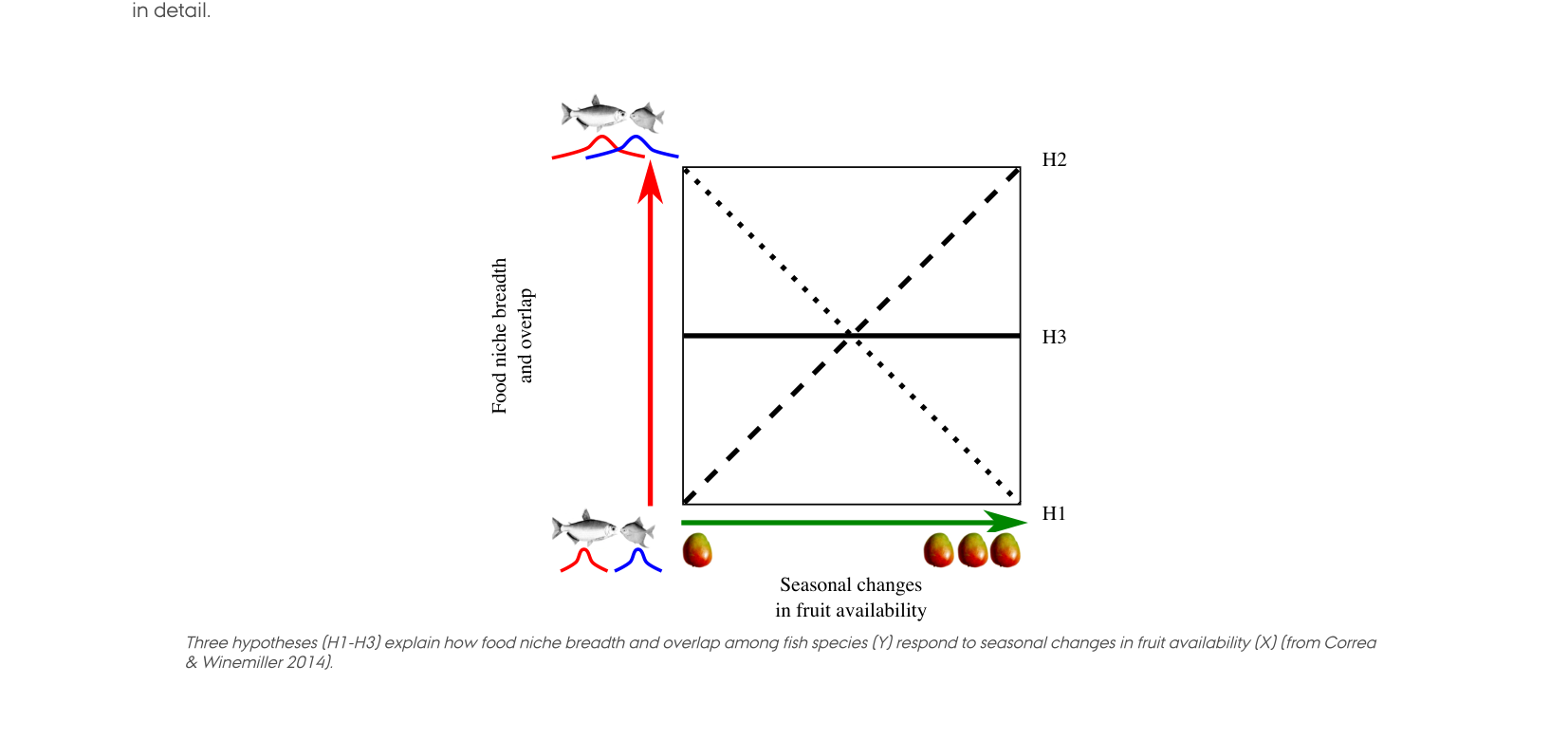 Figure 1.
Using the information and data, determine which of the statements are true or which are false.
Question reproduced from IBO 2015, Theoretical Exam A, licensed under CC BY-NC-SA 4.0 - attributed to the International Biology Olympiad. Open the full exam PDF · Community solutions (unofficial)