Q24 - Testing the Janzen–Connell Hypothesis with Pesticide Exclusion
Tropical forest plant communities are very diverse. The Janzen–Connell hypothesis argues that insect herbivores and pathogens are positive drivers of this diversity. This was tested in a rainforest by excluding herbivores and pathogens through pesticide application and observing if this affected plant diversity and abundance (Fig.).
Effects of an insecticide and two fungicides upon: seedling diversity (A) and mean seedling abundance (B) of the forest community. Error bars represent 95% confidence intervals of the mean of all study sites with a given treatment (from Bagchi et al. 2014).
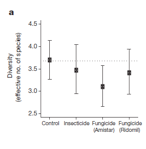 Figure 1.
Using the information and data, determine which of the statements are true or which are false.
Question reproduced from IBO 2015, Theoretical Exam B, licensed under CC BY-NC-SA 4.0 - attributed to the International Biology Olympiad. Open the full exam PDF · Community solutions (unofficial)