Q27 - Large Herbivore Decline and Dung Beetle Fauna Since the Last Glacial
Large herbivores have a high impact upon ecosystems, but most have become extinct during the last 100 kY (1kY = 1000 years). This mass extinction also affected their associated dung beetle fauna. Subfossil findings in Northern Europe show that this beetle fauna was richer and belonged to more open woodland before the mass extinction than afterwards, when dung beetles became fewer and most lived in closed forest. Modern humans and agriculture arrived to Northern Europe 50 kY and 10 kY ago, respectively.
Proportions of excavation sites classified according to their fossil dung beetle density (A), and vegetation type (B); the latter being identified by its characteristic beetle fauna. LI, last interglacial period (132–111 kY ago); LG, last glacial period (50–15 kY ago); EHol, early Holocene (10–5 kY ago); and LHol, late Holocene (2 kY ago to present) (from Sandom et al. 2014).
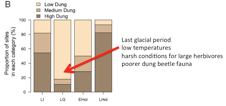 Figure 1.
Using the information and data, determine which of the statements are true or which are false.
Question reproduced from IBO 2015, Theoretical Exam B, licensed under CC BY-NC-SA 4.0 - attributed to the International Biology Olympiad. Open the full exam PDF · Community solutions (unofficial)