Q34 - Genotype-Dependent Outcomes of a Plant-Oomycete Interaction
The oomycete Hyaloperonospora arabidopsidis (Ha) grows on the plant Arabidopsis thaliana (At). Six genotypes of At (Pyr, Tsu, Sue, Fin, Tch and Gb) were grown with or without Ha in four experiments (Fig.A–D). In each experiment, the Ha sample differed: one came from a laboratory sample kept for years (B), one was collected in the field in Germany (C), another in France (D). Finally, one experiment (A) used a mix of the three others.
Seed production (mg seeds/plant; Y-axis) of six At genotypes (Pyr, Tsu, Sue, Fin, Tch, Gb; X-axis) in four experiments (a)–(d). At genotypes are ranked according to increasing seed production in the absence of the oomycetes (filled symbols, black); At grown with Ha (open symbols, red) (from Salvaudon et al. 2008).
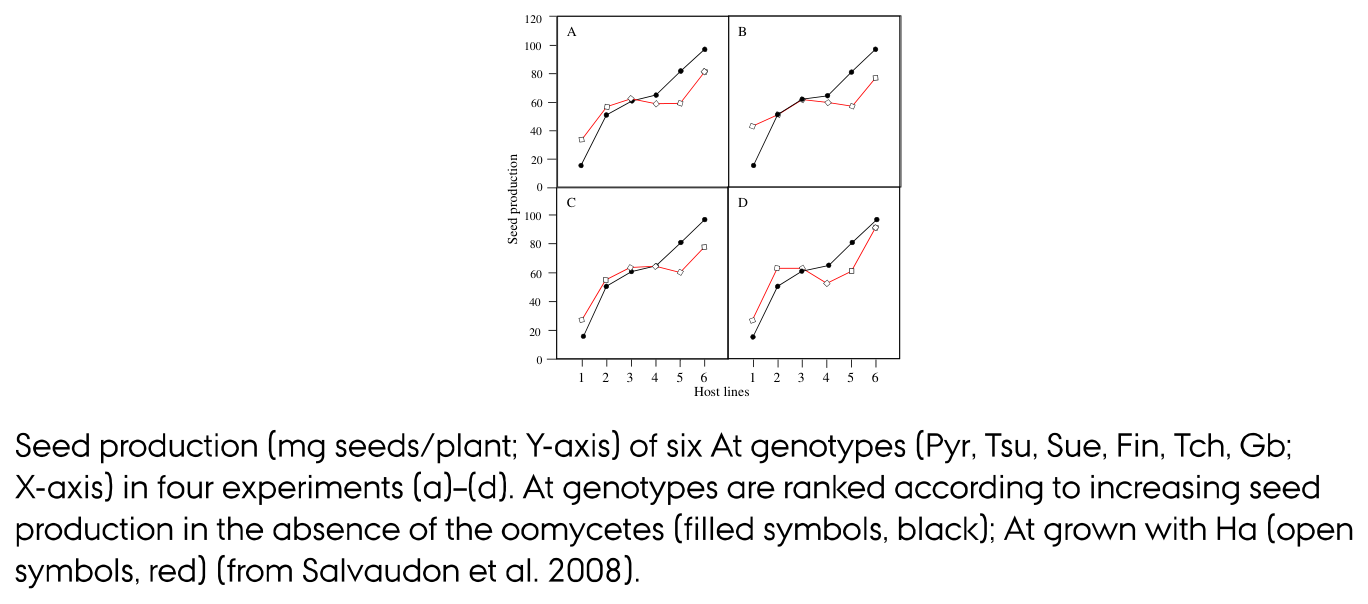 Figure 1.
Using the information and data, determine which of the statements are true or which are false.
Question reproduced from IBO 2015, Theoretical Exam B, licensed under CC BY-NC-SA 4.0 - attributed to the International Biology Olympiad. Open the full exam PDF · Community solutions (unofficial)