Q11 - Cell Wall Elasticity and the Components of Water Potential
Cell walls provide plant cells with a substantial degree of volume homeostasis relative to the large changes in water potential that they experience as the everyday consequence of transpirational water loss. Cell water potential (Ψw) of a plant cell is composed of solute potential (Ψs) and turgor pressure potential (Ψp). Relative cell volume is correlated with cell water potential and its components as described in Fig.Q11.
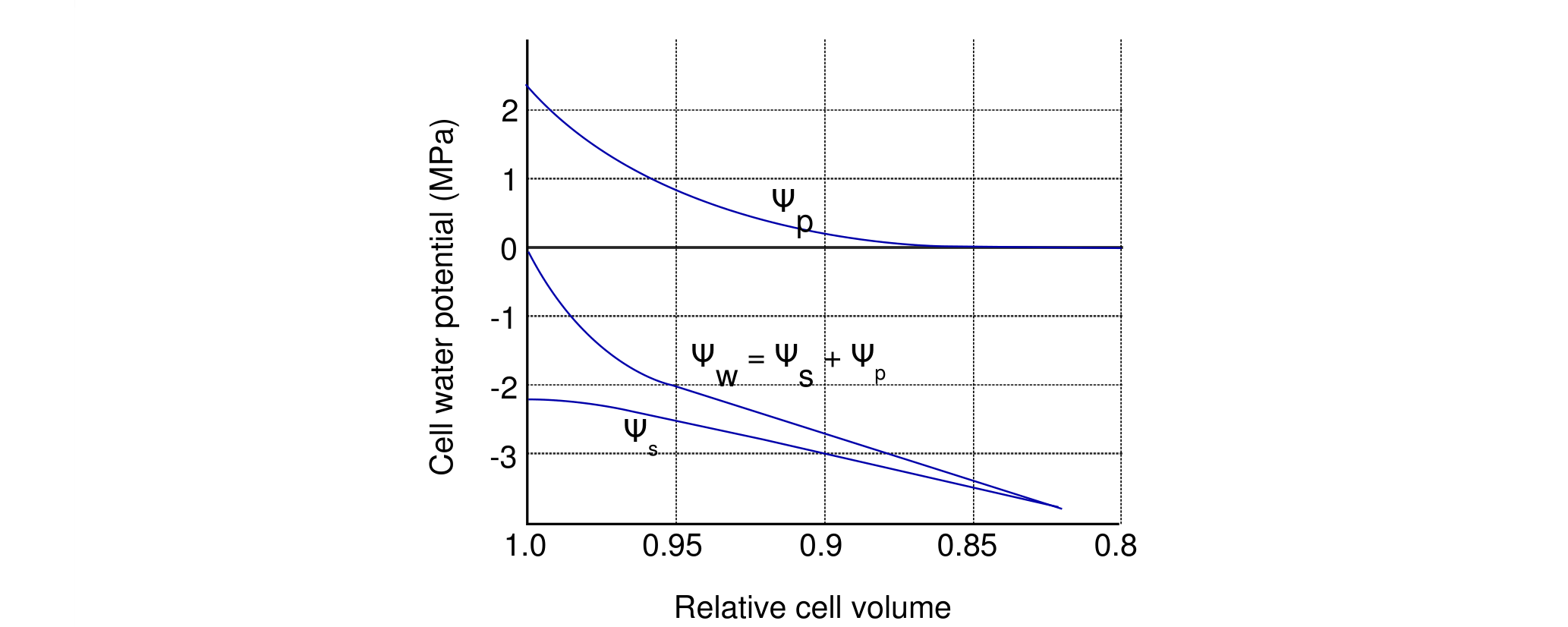 Figure 1.
Using the information and data, determine which of the statements are true or which are false.
A. Alterations of plant cell water potential are generally accompanied by a large change in turgor pressure and in cell volume.
B. Disappearance of turgor pressure indicates the ending point of cell plasmolysis with reduction of approximately by 15% cell volume.
C. As the cell volume decreases by 10%, most of the change in cell water potential is caused by the drop in cell solute potential together with little change in turgor pressure.
D. During cell rehydration, cell volume expansion stops when cell wall generates pressure equivalent to turgor pressure and the cell water potential reaches zero.
Question reproduced from IBO 2016, Theoretical Paper A, licensed under CC BY-NC-SA 4.0 - attributed to the International Biology Olympiad. Open the full exam PDF · Community solutions (unofficial)