Q35 - Classifying Crossover Events from Linear Tetrad Data
Centromere position can be mapped using linear tetrads in some fungi. If there is no cross-over between gene E and the centromere, four spores are arranged in a sequence of eeEE or EEee (Fig.Q.35A). If there is a cross-over between gene E and the centromere, four spores are arranged in a sequence of eEeE or EeEe (Fig.Q.35B). There are many types of crossovers involving 2, 3 and 4 strands of chromatids, as illustrated in Fig.Q.35C. Strain ab was crossed to strain a+ b+ and 100 linear tetrads were isolated. Those tetrads were divided into six classes as shown in the following table:
| Class 1 | Class 2 | Class 3 | Class 4 | Class 5 | Class 6 | |
|---|---|---|---|---|---|---|
| Spore 1 | ab | ab | ab | ab | ab+ | ab |
| Spore 2 | a+b | ab+ | ab | a+b+ | a+b | a+b+ |
| Spore 3 | ab+ | a+b | a+b+ | ab | ab+ | ab+ |
| Spore 4 | a+b+ | a+b+ | a+b+ | a+b+ | a+b | a+b |
| Count | 15 | 29 | 47 | 2 | 2 | 5 |
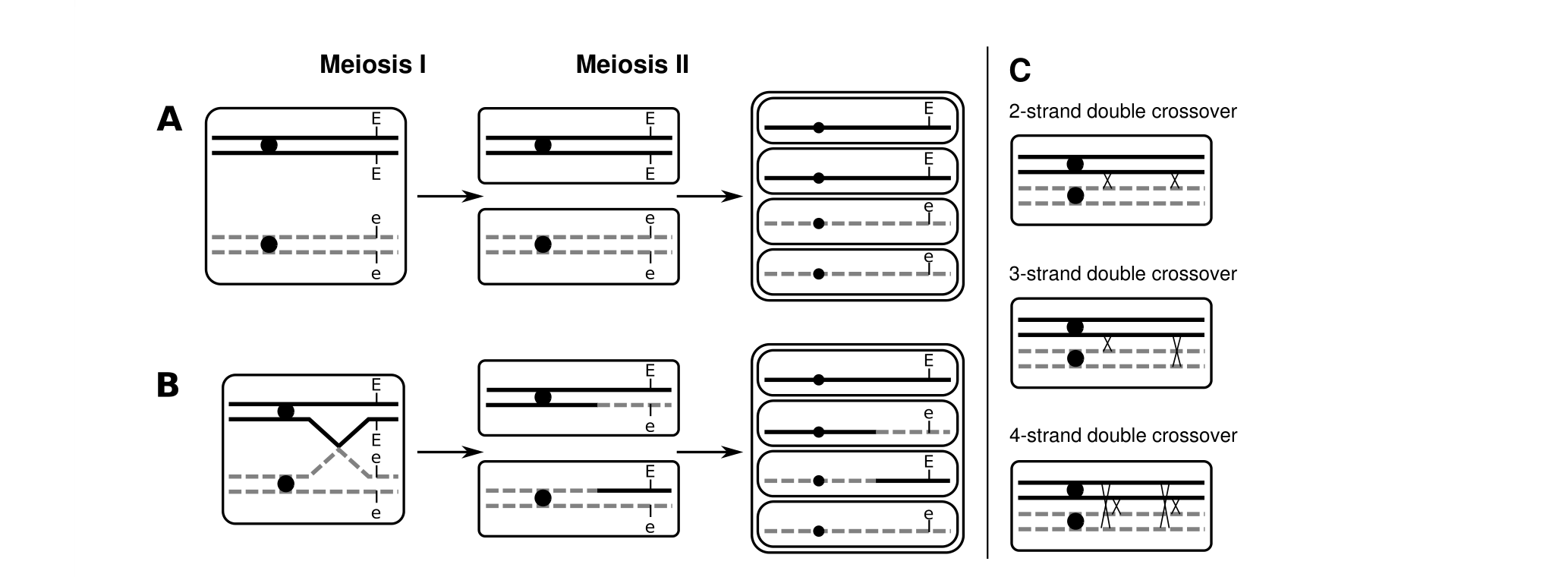 Figure 1.
Using the information and data, determine which of the statements are true or which are false.
Question reproduced from IBO 2016, Theoretical Paper A, licensed under CC BY-NC-SA 4.0 - attributed to the International Biology Olympiad. Open the full exam PDF · Community solutions (unofficial)