Q30 - Radar-Tracked Foraging Reveals Bee Route Memory, Not Optimisation
Radar, invented in the UK, was used to track the flight of English bees (Apis mellifera). To investigate how bees forage, the following experiment was performed: (1) Fake flowers were filled with syrup, and the bees were released from a nest-box. (2) Bees were given time to build experience of the setup. (3) Syrup was removed from one flower, leaving it empty, and placed in another. (4) Bees were allowed to build experience of the new set up. Representative flights are shown (a & b).
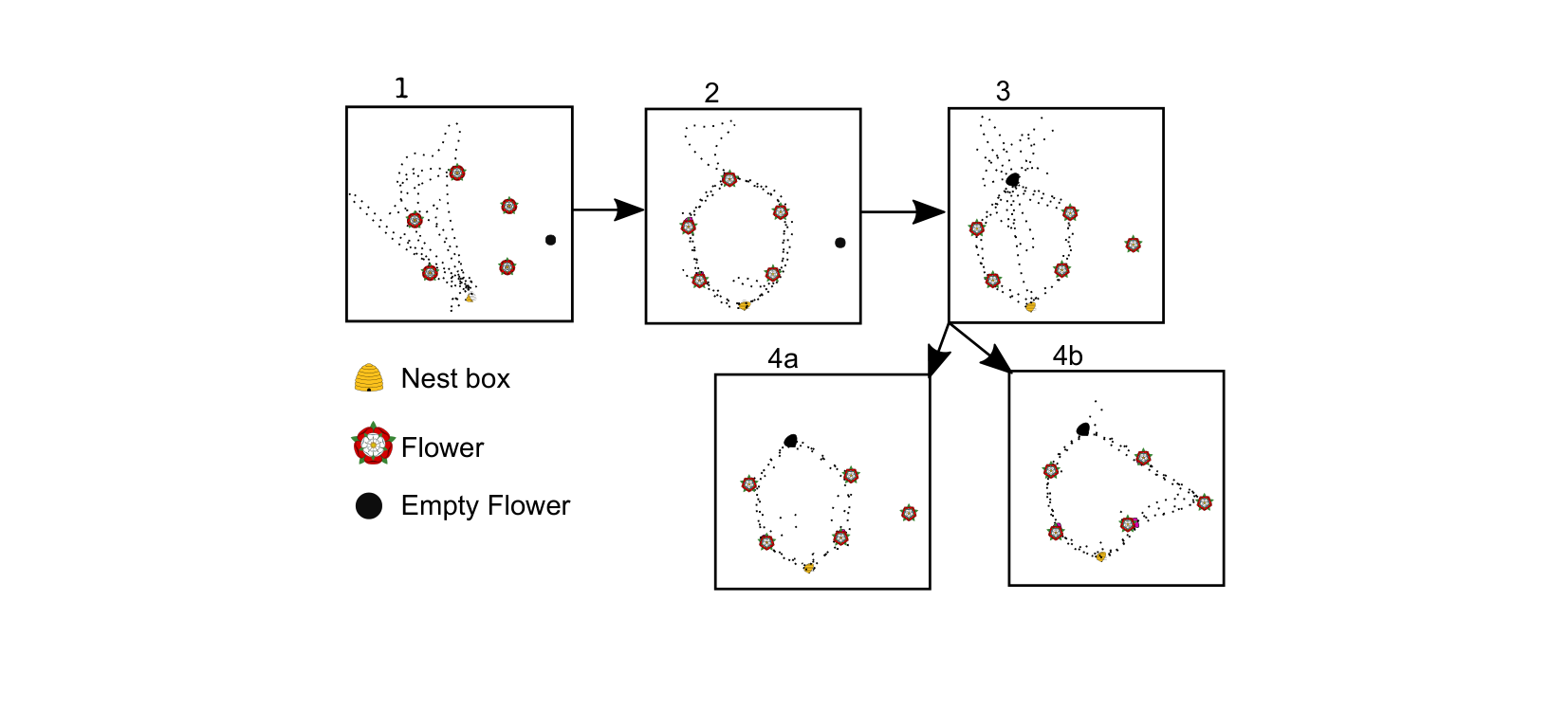
Using the information and data, determine which of the statements are true or which are false.
Question reproduced from IBO 2017, Theoretical Exam A, licensed under CC BY-NC-SA 4.0 - attributed to the International Biology Olympiad. Open the full exam PDF · Official answer key & worked solutions