Q22 - Ancient DNA Reveals the Beaker People Replaced, Not Joined, Britain
Stonehenge was built in the late Neolithic (Stone age; ~ 3000 BC) on what was Europe’s most important trade route, between Cornwall and the Eastern Mediterranean. In the Early Bronze age (~ 2500 BC), the Beaker phenomenon swept across Europe, and many peoples began producing characteristic pottery (1). To discover whether British people bought and made Beaker pots, or Britain was invaded by a people that did, remains from different sites were genome sequenced. The average proportion of alleles originating from different populations (colours) in the genomes of Neolithic, Beaker and Late Bronze Age individuals was compared (2). Rs4988235(T) is an allele of the gene for the enzyme lactase which causes it to be produced into adulthood. Its frequency in British people through time was measured (3). Lactose is a sugar in milk.
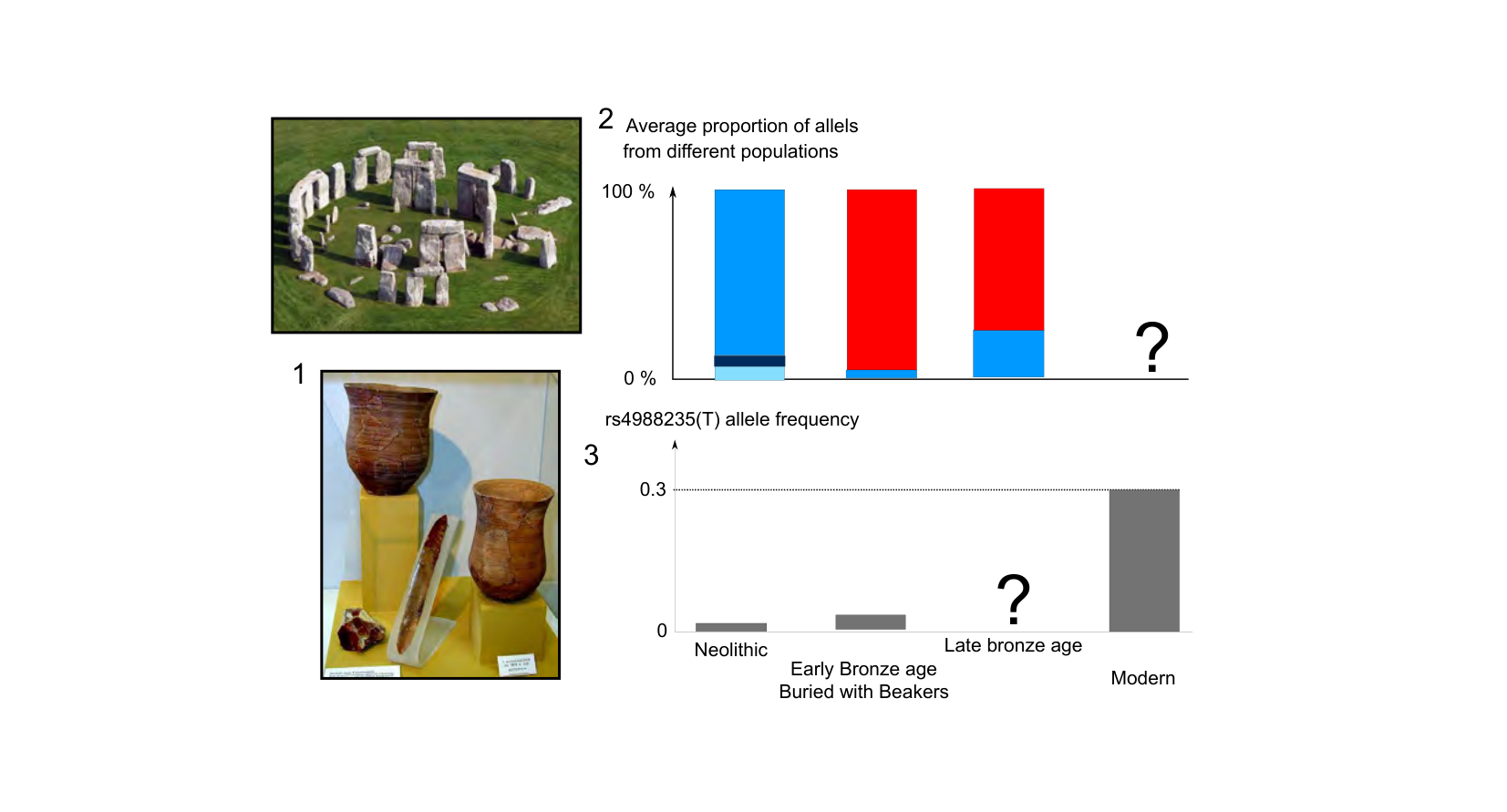
This question mixes multiple-choice/numeric-estimate parts with True/False statements - answer each part using the information and data above.
Question reproduced from IBO 2017, Theoretical Exam B, licensed under CC BY-NC-SA 4.0 - attributed to the International Biology Olympiad. Open the full exam PDF · Official answer key & worked solutions