Q4 - Carbon Monoxide's Real Effect on Oxygen Transport
Sir John Kendrew (1917-1997) published the structure of haem-proteins, revealing how oxygen is transported in the blood. Carbon monoxide is a poisonous gas which can enter the blood via the lungs and alters oxygen transport. In normal air, Po = 100 mmHg in the lungs. After addition of CO, so Pco = 0.4 mmHg, there are equal molar 2 amounts of CO and O in the blood. 2
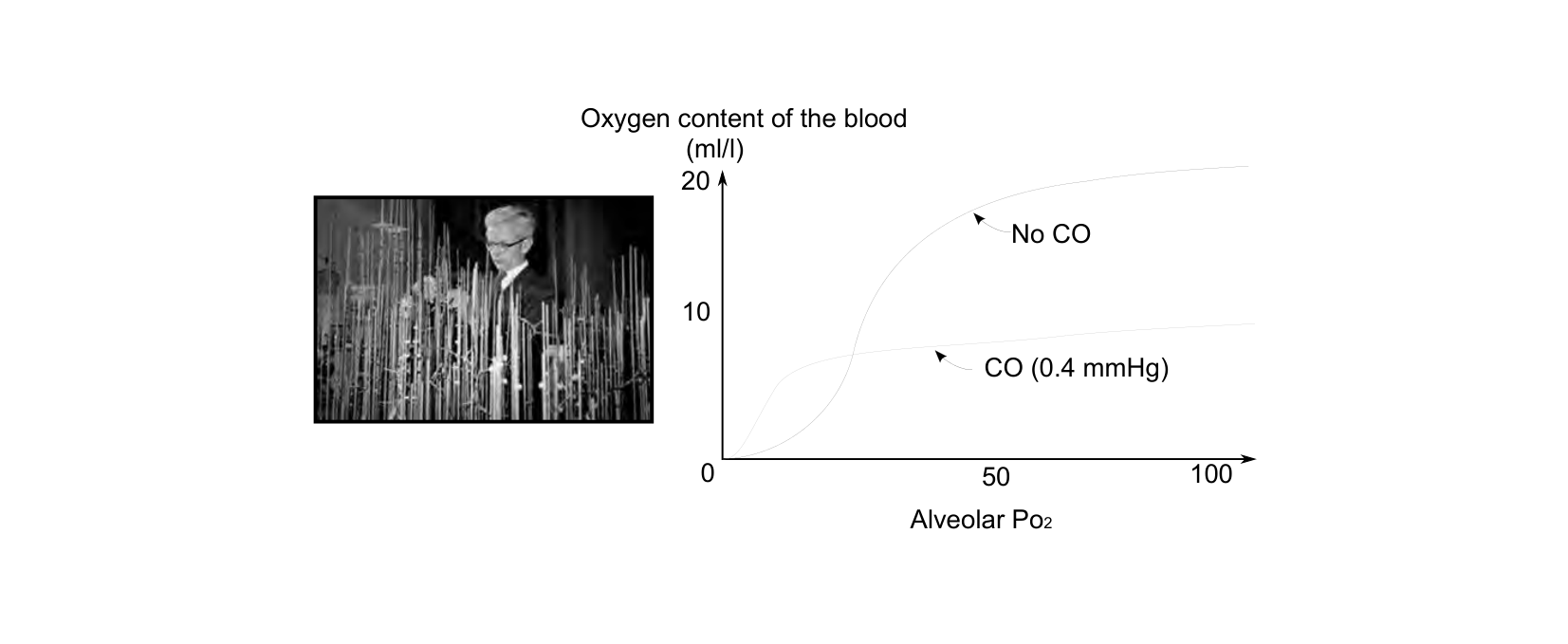
This question mixes multiple-choice/numeric-estimate parts with True/False statements - answer each part using the information and data above.
A. Carbon monoxide increases the affinity ('tightness of binding') of haemoglobin for oxygen.
B. 0.4 mmHg of carbon monoxide reduces the solubility of oxygen in plasma.
C. Carbon monoxide reduces the amount of functional heamoglobin in the blood in physiological conditions.
D. Given equal molar amounts of CO and O2 in the blood at Pco = 0.4 mmHg and normal alveolar Po2 = 100 mmHg, about how many times greater is haemoglobin's affinity for CO than for O2?
Question reproduced from IBO 2017, Theoretical Exam B, licensed under CC BY-NC-SA 4.0 - attributed to the International Biology Olympiad. Open the full exam PDF · Official answer key & worked solutions