Q10 - Yeast Mating and Polygenic Complementation
Mating experiments with a yeast species that has 16 chromosomes of equal length were performed. Results of mating between two mutant yeast strains (shown with an unhappy phenotype), each with a mutation in a single gene, are shown below. The mutated allele of each gene is recessive with respect to the wild type allele. Unhappy is polygenic and many genes affect the phenotype. Recombination does not occur in these yeast strains.
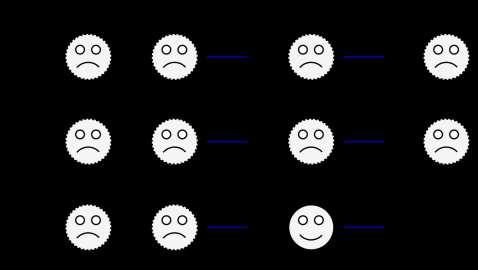 Figure 1.
Using the information and data, determine which of the statements are true or which are false.
A. If mutations of m1 and m2 were in the same gene, it is possible that all products of meiosis of cross 3 will be unhappy.
B. If 1 happy to 3 unhappy yeasts were produced from meiosis of cross 3, then the mutation of m1 and the mutation of m2 were in different genes.
C. If 1 happy to 1unhappy yeasts were produced from meiosis of cross 3, then the mutation of m1 and the mutation of m2 can suppress each other.
D. If the experiments were performed with various pairs of unhappy mutants, the most frequently observed ratio of happy to unhappy yeasts among meiosis products of cross 3 would be 1:3.
Question reproduced from IBO 2018, Theoretical Paper 1, licensed under CC BY-NC-SA 4.0 - attributed to the International Biology Olympiad. Open the full exam PDF · Community solutions (unofficial)