Q32 - Speciation and Extinction Rates Across Plant Habits
An important question in the evolution of angiosperms is the influence of life form and habit on speciation and extinction. In a phylogenetic study of the morphologically highly diverse plant order Saxifragales, the effect of habit and life history on speciation and extinction was investigated. Figures A-F illustrates estimates of speciation (lambda) and extinction (mu) rates in annual, perennial, herbaceous, and woody lineages (Soltis et al., 2013). The results are given as posterior probability density, which reflect the uncertainty associated with parameter estimates. Dashed lines represent the median values of each distribution. Net diversification rate r = lambda - mu. Posterior probability density is a function that use to specify the probability of the random variable falling within a particular range of values.
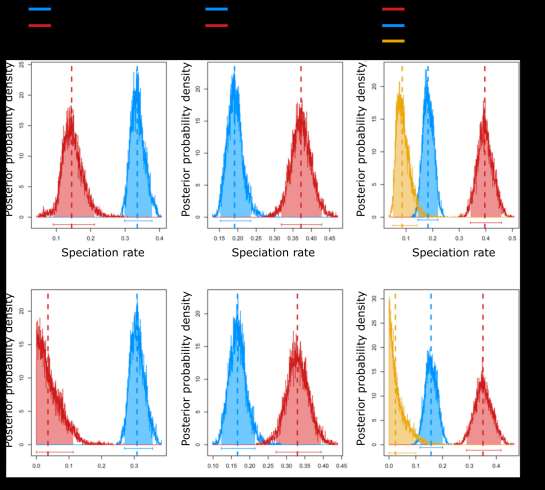 Figure 1.
Using the information and data, determine which of the statements are true or which are false.
Question reproduced from IBO 2018, Theoretical Paper 1, licensed under CC BY-NC-SA 4.0 - attributed to the International Biology Olympiad. Open the full exam PDF · Community solutions (unofficial)