Beadle and Tatum proposed that one gene produces one enzyme. They mutated mould and observed that different colonies required a different supplement to their normal media to survive.
Indicate which colonies (1–8) each statement is true for, based on Figure 1.
In another experiment, a different set of mutants was plated as seen in Figure 2.
Fig.2. Legend 1 = Rich Medium. Legend 2 = Rich Medium without Arginine.
Q8.1 (colony 1). Colony 1 has the same nutritional requirements as WT (grows on minimal medium alone, no supplement needed).
Q8.1 (colony 2). Colony 2 has the same nutritional requirements as WT.
Q8.1 (colony 3). Colony 3 has the same nutritional requirements as WT.
Q8.1 (colony 4). Colony 4 has the same nutritional requirements as WT.
Q8.1 (colony 5). Colony 5 has the same nutritional requirements as WT.
Q8.1 (colony 6). Colony 6 has the same nutritional requirements as WT.
Q8.1 (colony 7). Colony 7 has the same nutritional requirements as WT.
Q8.1 (colony 8). Colony 8 has the same nutritional requirements as WT.
Q8.2 (colony 1). Colony 1 would be useful for discovering genes involved in the arginine synthesis pathway (i.e. it needs arginine specifically, and grows on minimal medium only when arginine is added, not otherwise).
Q8.2 (colony 4). Colony 4 would be useful for discovering genes involved in the arginine synthesis pathway.
Q8.2 (colony 6). Colony 6 would be useful for discovering genes involved in the arginine synthesis pathway.
Q8.2 (colony 7). Colony 7 would be useful for discovering genes involved in the arginine synthesis pathway.
Q8.3 (colony 2). In Fig.2 (Legend 1 = Rich Medium, Legend 2 = Rich Medium without Arginine), colony 2 cannot produce its own arginine.
Q8.3 (colony 3). In Fig.2, colony 3 cannot produce its own arginine.
Q8.3 (colony 4). In Fig.2, colony 4 cannot produce its own arginine.
Q8.3 (colony 5). In Fig.2, colony 5 cannot produce its own arginine.
Q8.3 (colony 8). In Fig.2, colony 8 cannot produce its own arginine.
Q8.4. A different set of 9 haploid yeast strains, each with a single mutation in the amino acid production pathway, were crossed pairwise to make diploids and tested for growth on medium lacking the amino acid (Table 1 on the exam page; "−" = no growth = failure to complement). Based on these results, at least how many genes are involved in this synthesis pathway?
Q8.4 uses a different set of arginine-synthesis mutant strains: 9 haploid yeast strains, each with a single mutation in the amino acid production pathway, crossed pairwise to make diploid progeny grown on medium deficient in the amino acid of interest ("−" = no growth):
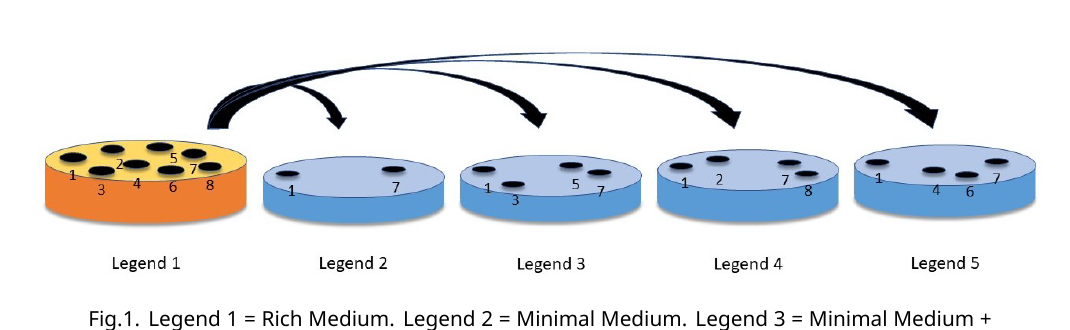 Fig.1. Legend 1 = Rich Medium. Legend 2 = Minimal Medium. Legend 3 = Minimal Medium + Phenylalanine. Legend 4 = Minimal Medium + Leucine. Legend 5 = Minimal Medium + Arginine.
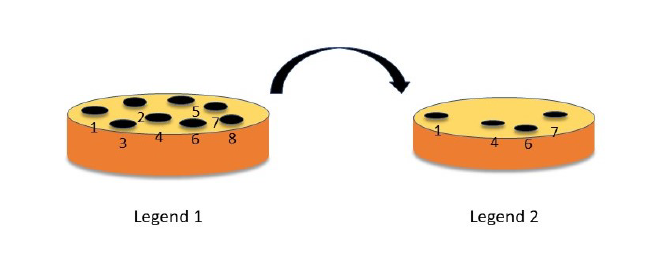 Fig.2. Legend 1 = Rich Medium. Legend 2 = Rich Medium without Arginine.