Q3 - Carbon Isotope Fractionation in C3 versus C4 Photosynthesis
When carbon isotopes (13C and 12C) are analyzed, plants can be categorized into two groups (Figure 1), based on the isotope fractionation (d13C, equation 1). This is because of the slight differences in molecular mass between 13CO2 and 12CO2, although there are no known chemical differences between them. In photosynthesis, two types of carboxylase enzymes fix carbon from CO2 in the two groups, provided that CO2 is converted to H2CO3 by an enzyme carbonic anhydrase. Reaction 1: C3H5O6P + H2CO3 -> C4H4O5 + H3PO4 (C4 plants) Reaction 2: C5H12O11P2 + CO2 + H2O -> 2 C3H7O7P (C3 plants)
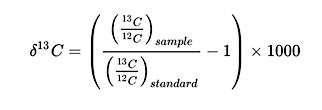 Figure 1.
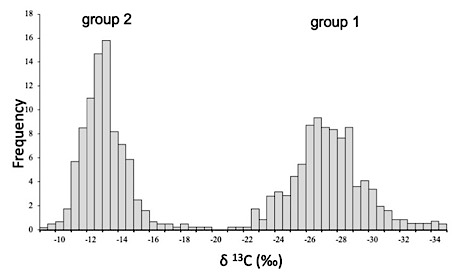 Figure 2.
Using the information and data, determine which of the statements are true or which are false.
Question reproduced from IBO 2020, Theoretical Exam 1, licensed under CC BY-NC-SA 4.0 - attributed to the International Biology Olympiad. Open the full exam PDF · Community solutions (unofficial)