Q7 - Glucosinolate Distribution and Herbivore Choice in Arabidopsis Leaves
“Secondary metabolism” in microorganisms and plants is not essential for their survival, but is a metabolic process that plays an important role depending on species or in environmental adaptation. Many secondary metabolites accumulated by plants, such as nicotine and caffeine, play a role in resistance to damage from herbivorous insects. Glucosinolate, which is accumulated in the leaves of Arabidopsis thaliana, is a repellent for herbivorous insects (Helicoverpa armigera). The leaves of the wild type (Wild) and the leaves of the mutant (Mutant) incapable of synthesizing glucosinolate are arranged as shown in Figure 1. The following conclusions can be assumed from this experiment. Indicate whether each of the following statements is true or false
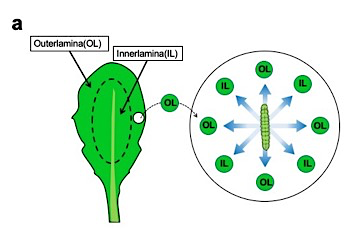 Figure 1.
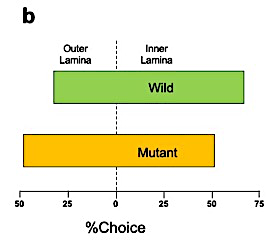 Figure 2.
Using the information and data, determine which of the statements are true or which are false.
Question reproduced from IBO 2020, Theoretical Exam 1, licensed under CC BY-NC-SA 4.0 - attributed to the International Biology Olympiad. Open the full exam PDF · Community solutions (unofficial)