Q34 - Two-Preceding-Leaf Rule for Leaf Positioning in the Fibonacci Spiral
Plant leaves are arranged around the stem in regular patterns. A typical example is the Fibonacci spiral, where the angle between successive leaves is near the golden angle of 137.5 degrees. It is considered that the position of new leaf formation is determined under the epidermis-transmitted inhibitory effect from existing leaves. Researchers made a shallow cut on the surface at the adaxial side of the incipient leaf P0 to isolate it from the apical region, and measured the deviation from 137.5 degrees of the angles between successive leaves after the next leaf P1 and second-next leaf P2 formed. The deviation was small for most angles except angle P-1OP2, which showed a large (about 40 degree) deviation from 137.5 degrees.
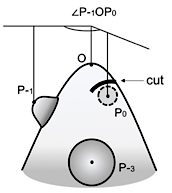 Schematic drawing of the microsurgical
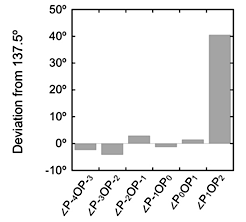 Deviation of the angle between experiment successive leaves from 137.
Using the information and data, determine which of the statements are true or which are false.
Question reproduced from IBO 2020, Theoretical Exam 2, licensed under CC BY-NC-SA 4.0 - attributed to the International Biology Olympiad. Open the full exam PDF · Community solutions (unofficial)