Q37 - Tracking Hox Cluster and Gene Duplication History Through Vertebrate Phylogeny
During the evolutionary history of vertebrates, they experienced several instances of whole-genome duplication that are believed to facilitate genome diversification and dynamic evolution. A. Figure 1 shows the phylogenetic tree of a broad range of vertebrates and lancelet (an ancestor of vertebrates) with the timing of whole-genome duplications (black arrowheads) marked on the tree. The lancelet possesses one Hox gene cluster in the genome, and Hox gene clusters are rarely lost during evolution. B. In the phylogenetic tree of species X, Y, and Z, whole-genome duplication occurred two times (black arrowheads, Figure 2 left), so each of species X, Y, and Z possesses two paralogous genes (X1/X2, Y1/Y2, Z1/Z2). Enough time has passed between gene duplication and the subsequent speciation.
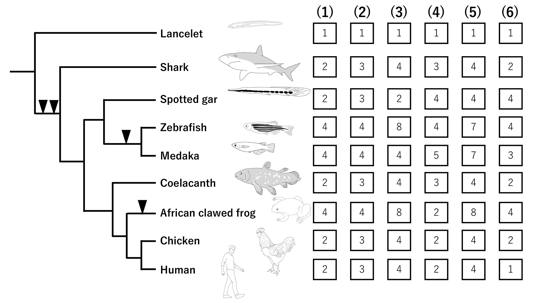 (left) The phylogenetic tree of a broad range of vertebrates and lancelet (an ancestor of vertebrates). (right) The answer options for the number of Hox gene clusters in each species from (1) to (6).
Using the information and data, determine which of the statements are true or which are false.
Question reproduced from IBO 2020, Theoretical Exam 2, licensed under CC BY-NC-SA 4.0 - attributed to the International Biology Olympiad. Open the full exam PDF · Community solutions (unofficial)