Q44 - Tracing Detrital and Grazing Food-Web Pathways and Cesium Bioaccumulation Timing
Figure 1 shows a simplified food web in temperate forests. Spiders (generalist predators) consume herbivores (40%) and detritivores (60%). Passerine birds (generalist predators) consume herbivores (50%), spiders (30%), and detritivores (20%). Detrital insects spend their larval period in soil but move aboveground as winged adults, becoming prey for spiders. Conversion efficiency between adjacent trophic levels is assumed to be 10%. 137Cs entered forest soil after the Fukushima accident, is difficult for vascular plants (and thus herbivores) to absorb from roots years later, but fungi absorb and accumulate it, which is then consumed by detritivores. Figure 2 shows three patterns (A, B, C) of how 137Cs concentration (relative to 1 in 2011) changes over several years for three organisms.
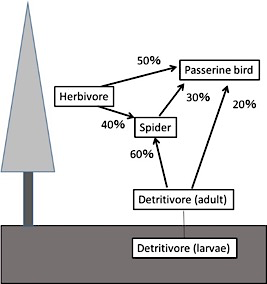 Figure 1.
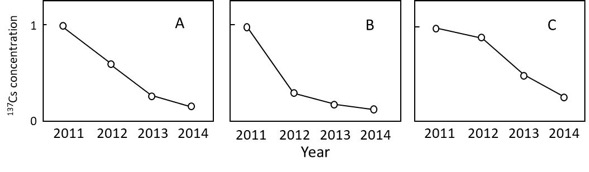 Figure 2.
Using the information and data, determine which of the statements are true or which are false.
Question reproduced from IBO 2020, Theoretical Exam 2, licensed under CC BY-NC-SA 4.0 - attributed to the International Biology Olympiad. Open the full exam PDF · Community solutions (unofficial)