Q15 - Sea Turtle Temperature-Dependent Sex Determination
Hawksbill turtles breed on Saadiyat Island in Abu Dhabi.
Sex in sea turtles is controlled by the temperature of the developing eggs (temperature-dependent sex determination). Higher temperatures lead to more females, and lower temperatures, to more males.
As the global climate is rapidly heating, there is a risk that many populations of long-lived sea turtles could develop biased sex ratios.
On average, female sea turtles, which have a prolonged reproductive period extending to 60 to 70 years, mate once every three years, storing sperm within their bodies during this period, whilst the males try to mate every year. The figure below models the influence of temperature on the probability of eggs developing into females in two species of sea turtle.
 X = Temperature (°C), Y = Probability of a female hatchling. Curve a = Species 1, Curve b = Species 2.
Part A: If an individual of Species 1 has 150 eggs in a clutch, then, based on the model above, what would be the expected number of female hatchlings at 30°C?
Part B: True or false?
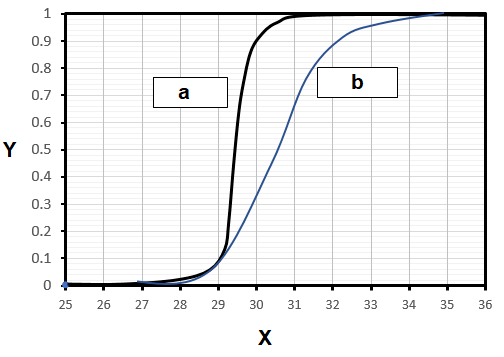 Detail of the two sigmoid curves near the pivotal temperature.
Question reproduced from IBO 2023, Theoretical Paper 1, licensed under CC BY-NC-SA 4.0 - attributed to the International Biology Olympiad. Open the full exam PDF