Q30 - Wheat Nitrogen Assimilation Under Elevated CO2
Wheat is grown on more land area than any other food crop, and it receives about 20% of the world’s nitrogen fertilizer.
In the well-drained soils usually used to grow wheat, NO3- is a major N-fertilizer form. If rising atmospheric CO2 levels significantly affect NO3- photoassimilation by wheat, alternative nitrogen fertilizers should be prepared.
Bloom et al. (2012) grew wheat seedlings in controlled environment chambers where CO2 was controlled at ambient or elevated levels (360 or 700 umol/mol), and the plants received either 0.2 mM NH4+ or 0.2 mM NO3- as the N source.
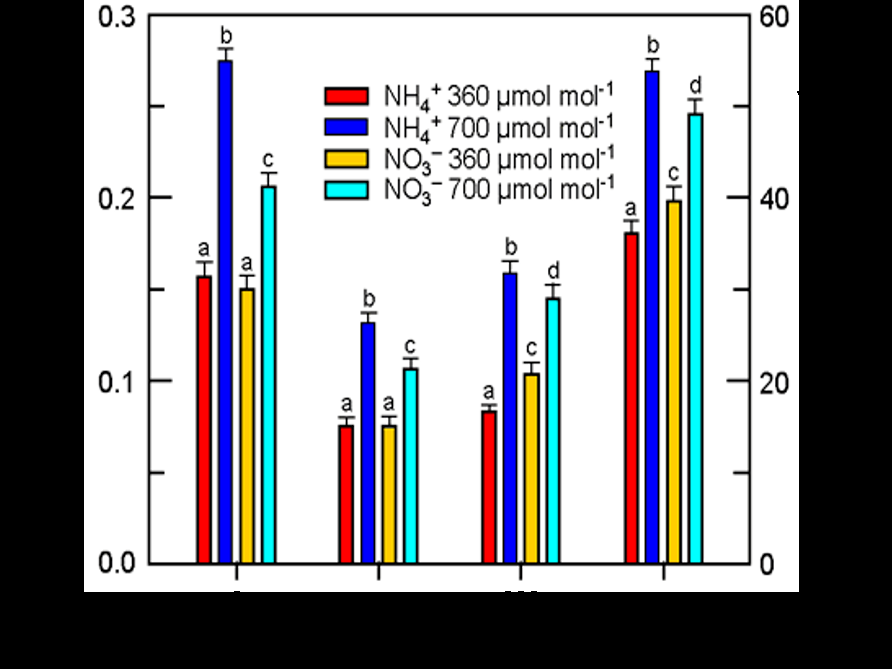 Figure 1. Biomass and leaf area of wheat seedlings grown for 14 days. Red = NH4+ at 360 umol/mol CO2, Blue = NH4+ at 700, Yellow = NO3- at 360, Cyan = NO3- at 700.
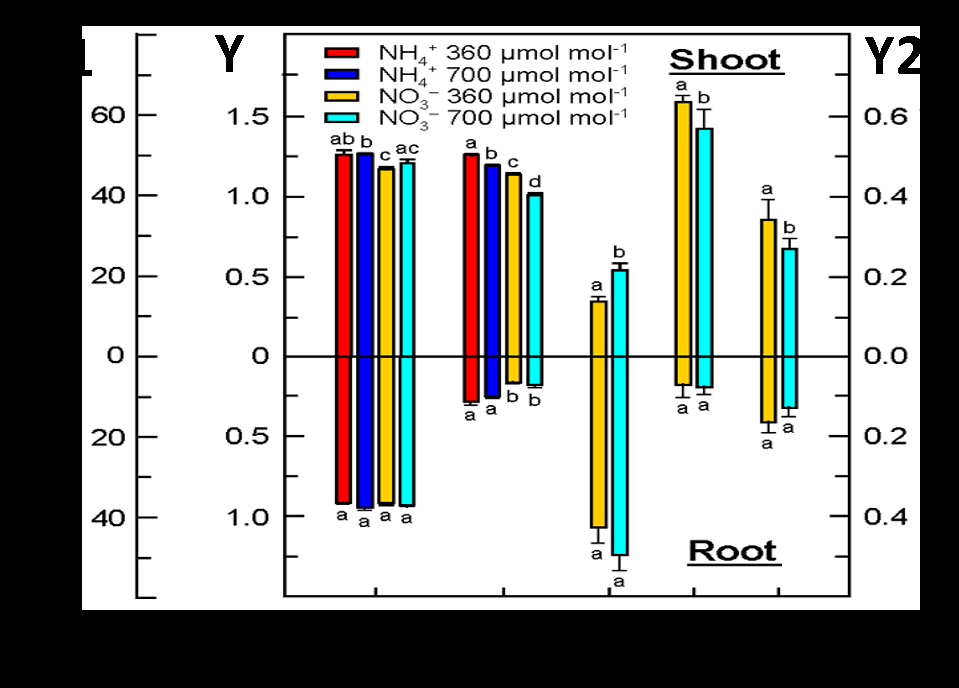 Figure 2. Nitrogen concentration, protein, NO3- levels, and enzyme activities in shoots (top) and roots (bottom). Same color scheme as Figure 1.
Question reproduced from IBO 2023, Theoretical Paper 1, licensed under CC BY-NC-SA 4.0 - attributed to the International Biology Olympiad. Open the full exam PDF