Q30 - Parasite-Mediated Competition in Squirrels
Parasite-mediated competition occurs in host species that live sympatrically (in the same place) and are differentially affected by parasite infections. Species that are badly affected by parasites may not be able to compete well with a sympatric species, except in situations where the parasite is absent.
Squirrels in Canada host the intestinal nematode Strongyloides robustus. However, nematode effects on the hosts are varied.
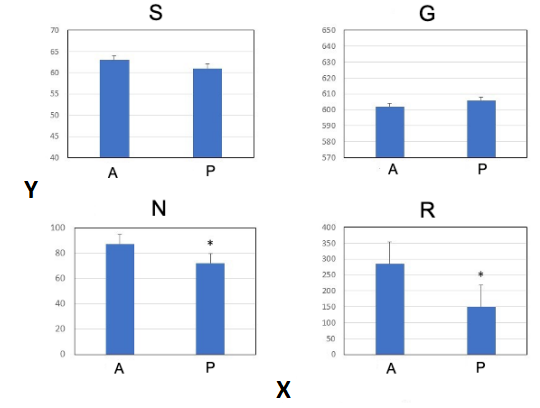
Researchers conducted a study to determine if parasite-mediated competition was occurring in squirrels. Four species of squirrel were trapped, and the presence of parasite eggs was determined. To assess the impact of the nematodes on the squirrels, the researchers measured Scaled Mass Index (SMI) as a measure of body condition; lower values indicate worse health.
The figure below shows the SMI for the four species. The error bars represent the standard error of the means. NOTE that the scales in the figures are different.
- S: Southern flying squirrel (Glaucomys volans)
- G: Grey squirrel (Sciurus carolinensis)
- N: Northern flying squirrel (Glaucomys sabrinus)
- R: Red squirrel (Tamiasciurus hudsonicus)
* Indicates a statistically significant difference.
The two nocturnal species of flying squirrels have different diets and foraging strategies from the diurnal red and grey squirrels.
True or False?
Question reproduced from IBO 2023, Theoretical Paper 2, licensed under CC BY-NC-SA 4.0 - attributed to the International Biology Olympiad. Open the full exam PDF