Q36 - Triceratops Skull Injuries
Some fossilised skulls of triceratops (a type of dinosaur) show injuries sustained while the animal was alive. The figure shows a drawing of a triceratops skull. Injuries in the highlighted bones were assessed across many fossils. The numbers give the number of individuals with injuries found in that bone, out of the total number of individuals in which that bone was analysed. The Squamosal bone is marked with an asterisk.
Two main causes of triceratops skull injuries are attacks by large predators (e.g. T. rex), or combat between adult male triceratops. Note that T. rex stood much taller than triceratops.
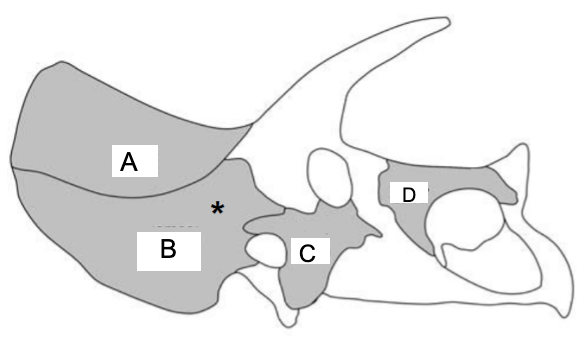
True or False?
Question reproduced from IBO 2023, Theoretical Paper 2, licensed under CC BY-NC-SA 4.0 - attributed to the International Biology Olympiad. Open the full exam PDF