Q54 - Climate Change Effects on Rapeseed Oil
Rapeseed (Brassica napus) is a major oilseed crop. Climate change factors, including elevated CO₂, increased temperature, and elevated ozone (O₃), can affect seed oil content and composition.
An experiment examined the individual and combined effects of three climate change factors on rapeseed oil quality:
- Elevated CO₂ (+260 ppm above ambient)
- Elevated temperature (+3°C above ambient)
- Elevated ozone (O₃, +50 ppb above ambient)
The figure shows the effects of individual factors and their combinations on total oil content and polyunsaturated fatty acid content.
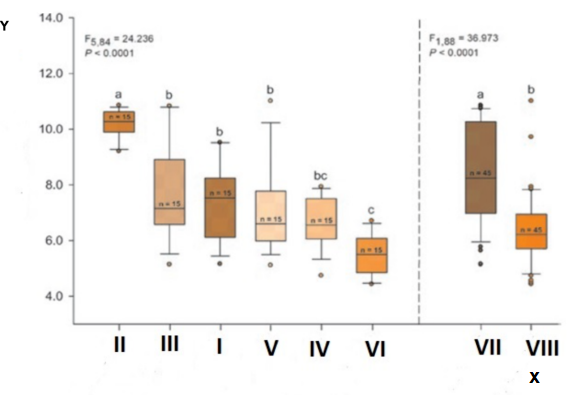
True or false?
Q54.1. Combined treatment with all three factors (O3 + CO2 + temperature) reduced the negative impacts on both total oil and polyunsaturated fatty acid content.
Q54.2. Elevated CO2 alone was the single factor with the greatest detrimental effect on seed oil quality.
Q54.3. All treatments significantly affected oil quality.
Q54.4. The results showed strong interactive effects of CO2, temperature and O3 on oil quality.
Question reproduced from IBO 2023, Theoretical Paper 2, licensed under CC BY-NC-SA 4.0 - attributed to the International Biology Olympiad. Open the full exam PDF