Q38 - Chemical A, Gibberellin, and Wheat Seed Germination
Kazakhstan is one of the significant contributors to global wheat production and export. Researchers at Kazakh National University studied how chemical A affects wheat (T. aestivum) development.
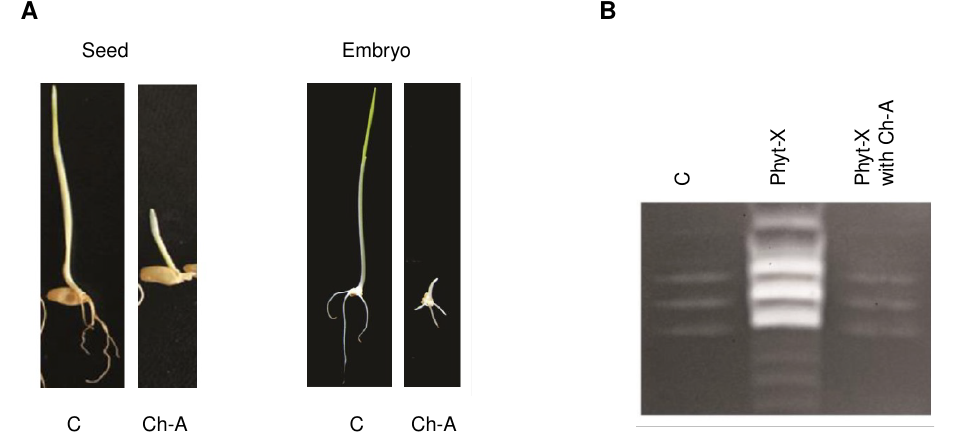 Figure 1. A The impact of chemical A (Ch-A) on the germination of seeds and isolated embryos (C: control). B The effect of chemical A on α-amylase activity in seeds (C: control). Briefly: wheat embryos were treated with chemical A and/or phytohormone X (Phyt-X), then total proteins were extracted and separated by polyacrylamide gel electrophoresis (PAGE). The gel was immersed in starch solution, then iodine solution was added - iodine reacts with starch to produce a dark black color and prevents a bright white color from appearing (as in panel B); glucose does not react with iodine.
On your answer sheet, indicate “T” for true statements and “F” for false ones.
Question reproduced from IBO 2024, Theoretical Exam Part B, licensed under CC BY-NC-SA 4.0 - attributed to the International Biology Olympiad. Open the full exam PDF