Q15 - Chloroplast DNA Haplotypes in a Rare Japanese Orchid
Genetic variation in three chloroplast DNA (cpDNA) regions was studied in populations of a rare orchid Vexillabium yakushimense. Material from nine populations on Honshu and two populations on the Japanese Nansei Islands (Yakushima and Okinawa) were sampled (Fig.). A–B, geographic distribution of 7 cpDNA haplotypes of V. yakushimense. Pies are populations, and each colour indicates a haplotype. The size of each coloured slice shows proportion of each haplotype in the population; C, parsimony network: circles a to g are seven different haplotypes in the 11 populations. Circle size indicates frequency of each haplotype. Linked haplotypes differ by only 1-2 mutations.
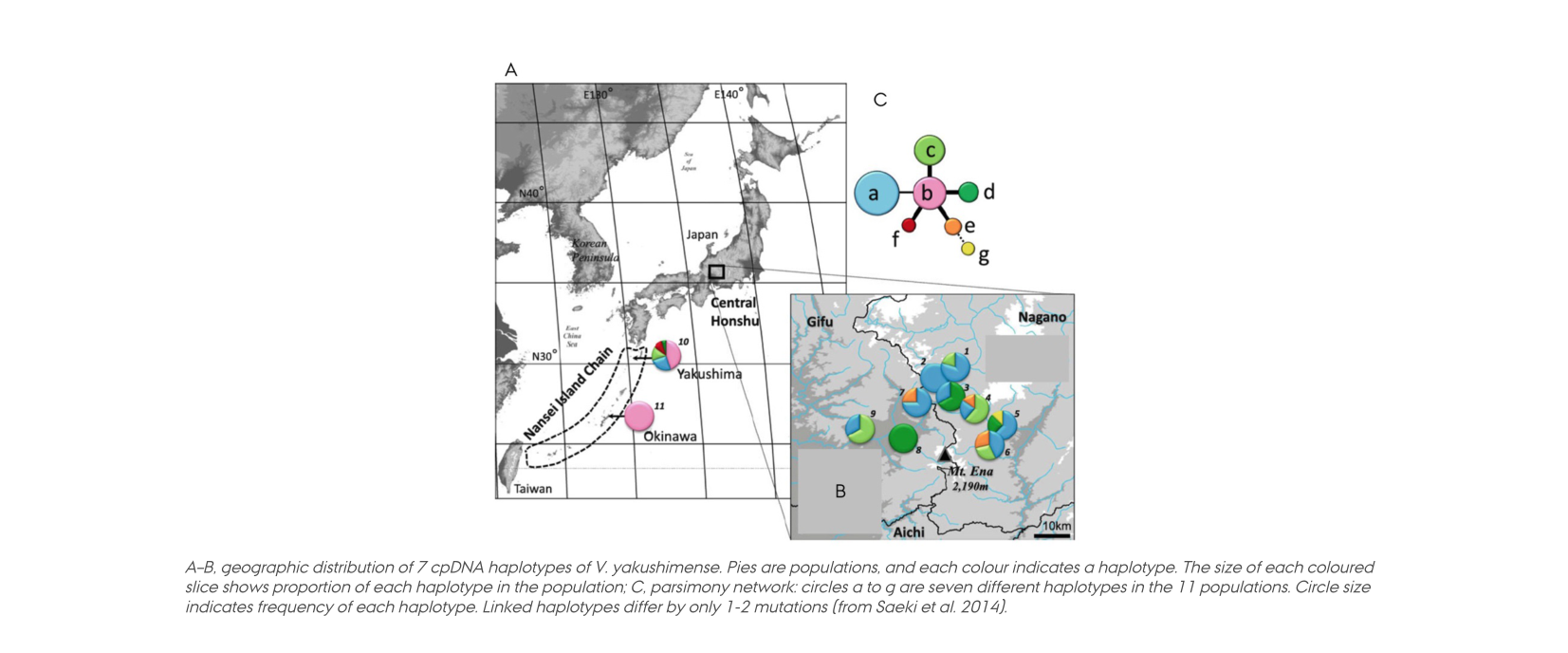 Figure 1.
Using the information and data, determine which of the statements are true or which are false.
Question reproduced from IBO 2015, Theoretical Exam A, licensed under CC BY-NC-SA 4.0 - attributed to the International Biology Olympiad. Open the full exam PDF · Community solutions (unofficial)