Q24 - Competing Hypotheses for Darwin's Finch Diversification
The Galápagos Islands are well known for the adaptive radiation of 14 species of finch. The drivers of this radiation are either competition for food in the community of finch species (Hypothesis 1), diversity of available food, i.e. seeds and fruits (Hypothesis 2), or both. Choice of diet is determined by size and structure of the beak. These hypotheses were tested using the six ground finches, which have very different beaks (Fig.). A, relationship between seed/fruit diversity within a habitat and breadth of seed/fruit diet of a finch population in the same habitat. B, relationship between ratio of beak depth of co-occurring pairs of finch species and overlap in consumed food items between a pair of species.
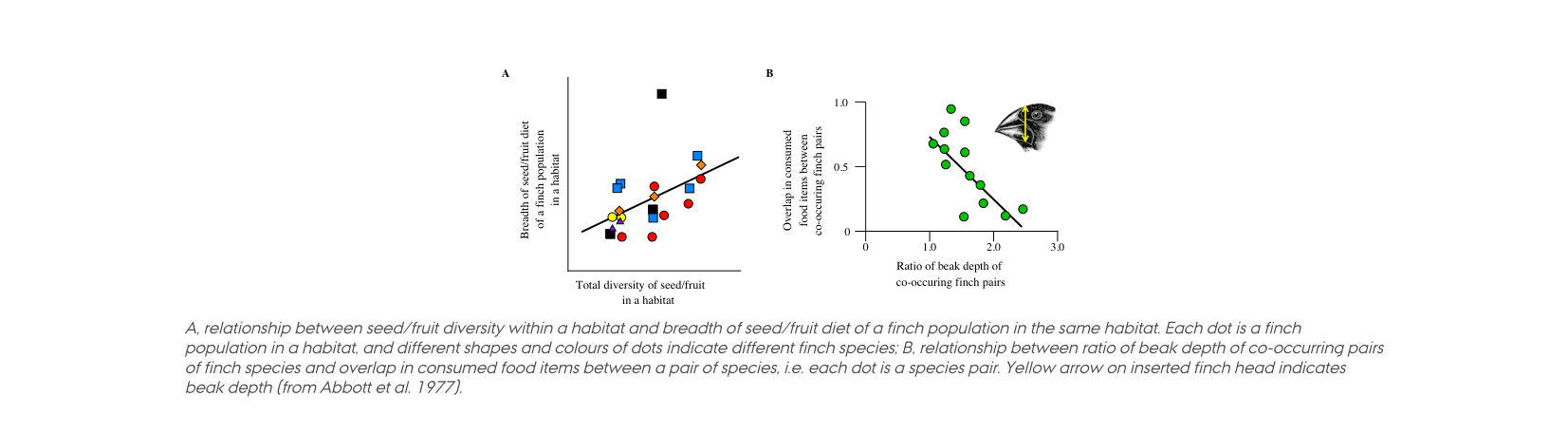 Figure 1.
Using the information and data, determine which of the statements are true or which are false.
Question reproduced from IBO 2015, Theoretical Exam A, licensed under CC BY-NC-SA 4.0 - attributed to the International Biology Olympiad. Open the full exam PDF · Community solutions (unofficial)