Q25 - Coevolutionary Arms Race Between Toxic Newts and Resistant Snakes
Rough-skinned Newts (a salamander) produce the toxin TTX, which is lethal to other vertebrates. Individual newts vary in their level of TTX. Garter Snakes eat almost any prey, including newts, and individual snakes vary in their resistance to TTX. The higher the TTX level in a newt population is, the greater the resistance of co-occurring snakes, which, however, still may reject newts, which are too poisonous (Fig.). Relationship between levels of resistance of snakes and toxicity of newts. Each dot represents a site with interacting snake and newt populations. In the white zone, snakes consume newts, but with a cost to their mobility. Dots in grey-coloured zones are toxicity/resistance mismatches.
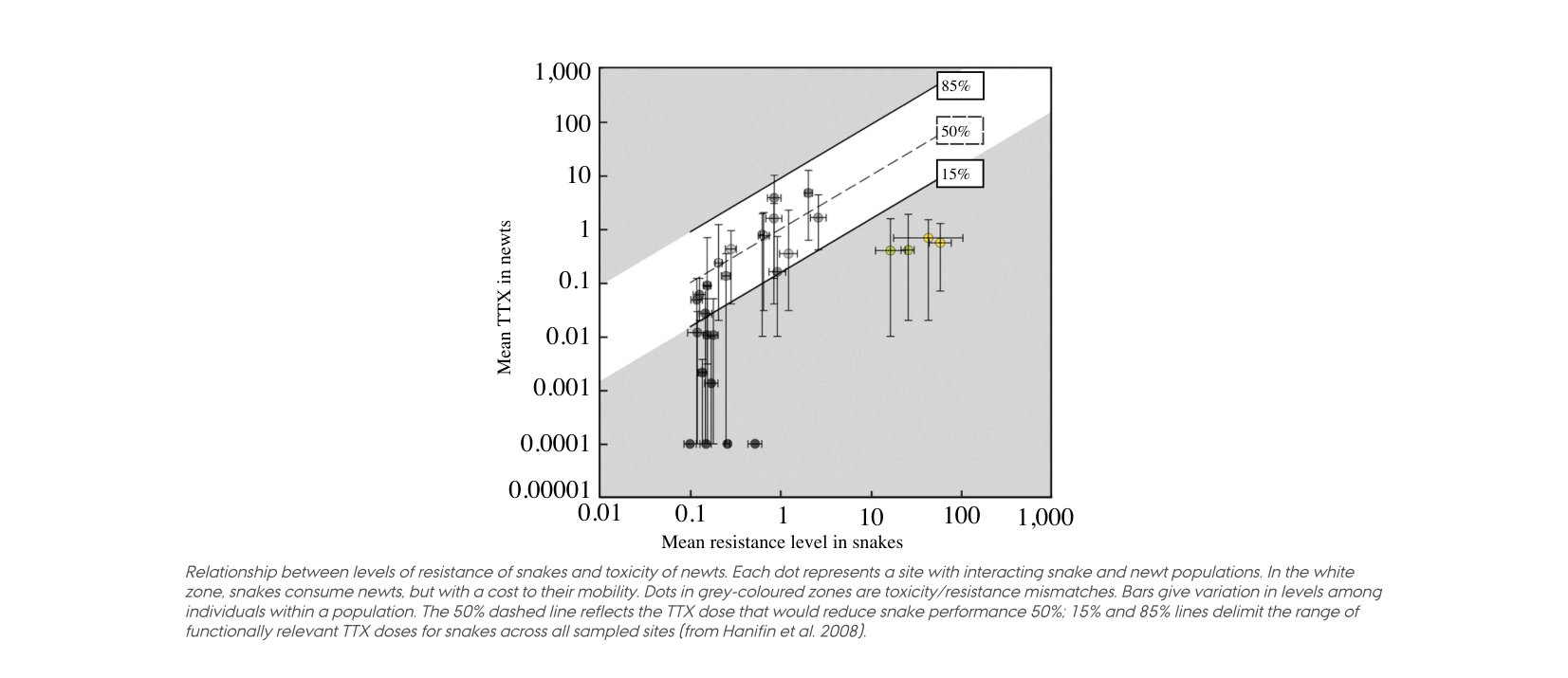 Figure 1.
Using the information and data, determine which of the statements are true or which are false.
Question reproduced from IBO 2015, Theoretical Exam A, licensed under CC BY-NC-SA 4.0 - attributed to the International Biology Olympiad. Open the full exam PDF · Community solutions (unofficial)