Q30 - Orientation Cages and Migratory Direction in Indigo Buntings
Stephen Emlen experimentally studied seasonal migration of an American bird, the Indigo bunting. He used a funnel-shaped test cage (Fig. B), at the bottom of which he placed an ink pad. Each time a bunting tried to fly out of the cage, the location of its footprint was marked by ink on a piece of paper, so its orientation pattern easily could be recorded (Fig. C). The bird migrates at night, using stars as cues. A, distributional range of the bird (pink area = summer range; blue area = winter area); B, Emlen’s experimental cage; and C, four examples of footprint pattern; each radius is a take-off attempt by the bird.
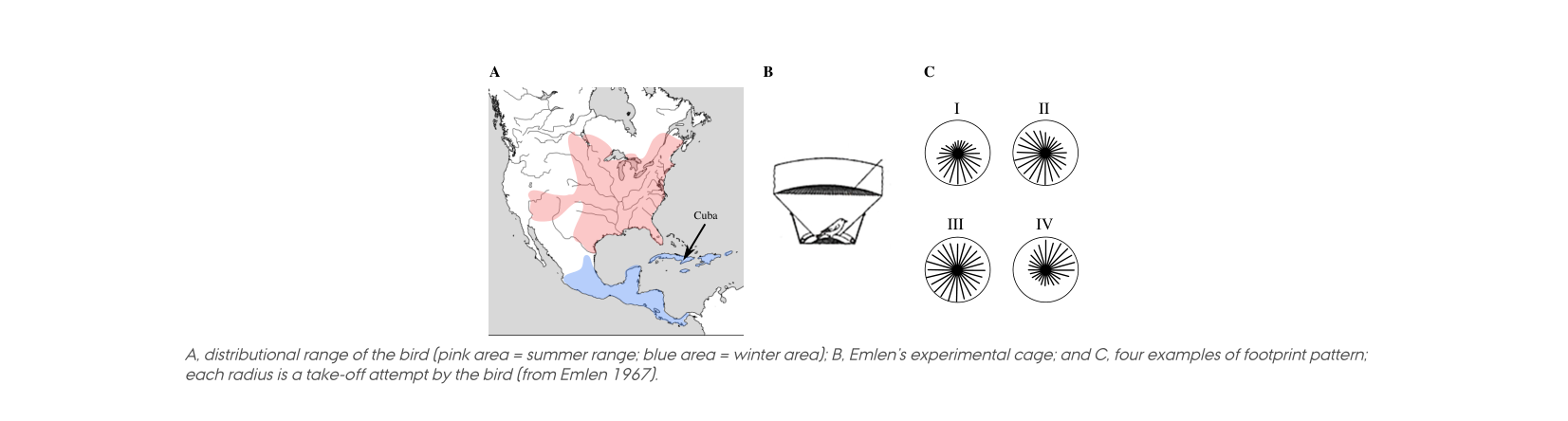 Figure 1.
Using the information and data, determine which of the statements are true or which are false.
Question reproduced from IBO 2015, Theoretical Exam A, licensed under CC BY-NC-SA 4.0 - attributed to the International Biology Olympiad. Open the full exam PDF · Community solutions (unofficial)