Q31 - Wind Adaptation and Flightlessness in an Island Butterfly
About 100 individuals of the butterfly Melitaea cinxia lives on a tiny island PT in the Gulf of Finland. Researchers studied how the butterflies on PT coped with the very windy conditions on the island. In the lab, they exposed butterflies from mainland and PT to a wind source (hair dryer) (Fig. B) and they also studied the morphology of the claws of the butterfly (Fig. C). A, wind speed in June on PT (blue) and mainland (gray); B, distance to wind source, when a butterfly loses its grip on a surface; old and young butterflies from mainland and PT are compared; C, The angle of curvature of tarsal claw on mainland and PT.
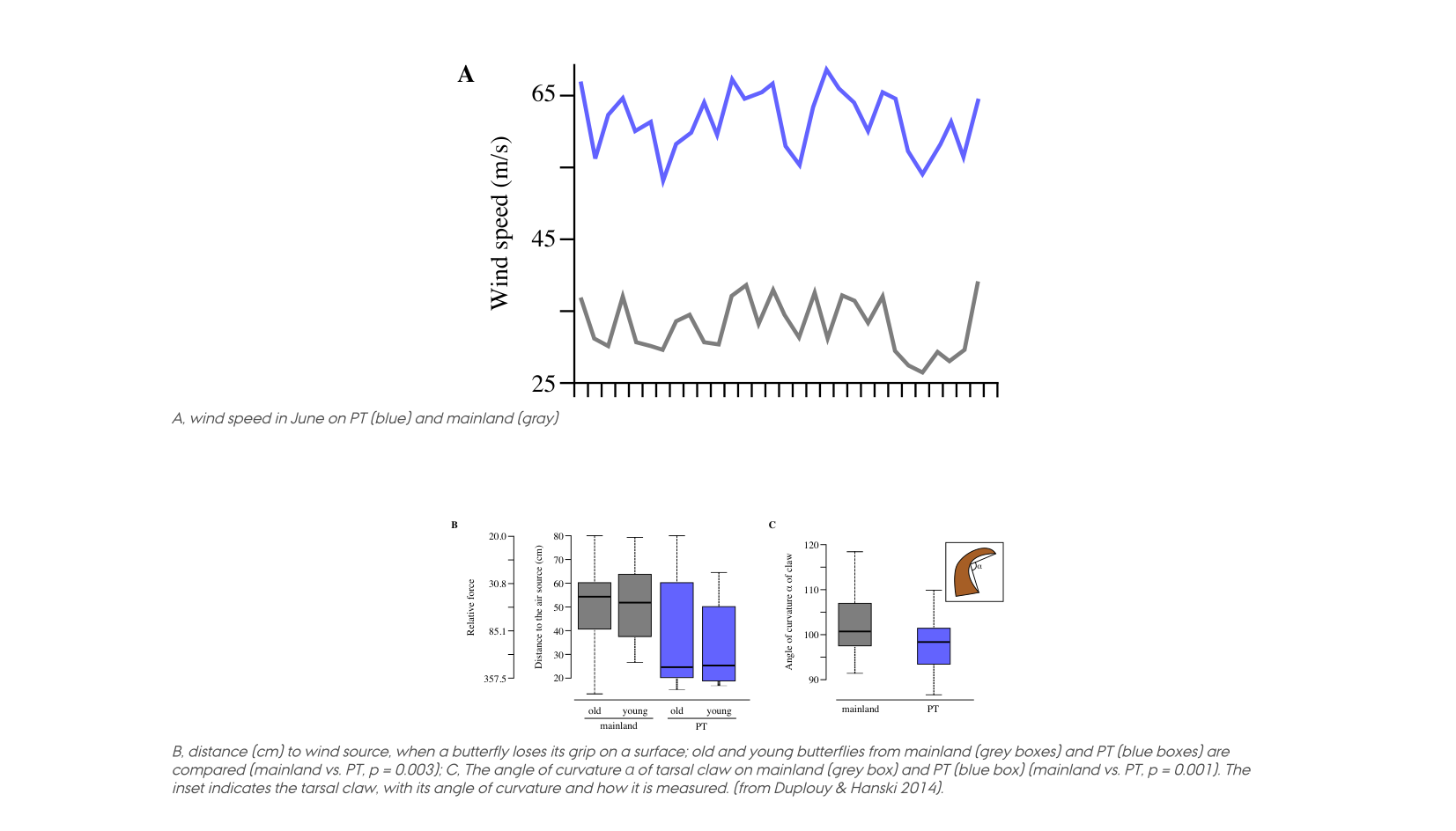 Figure 1.
Using the information and data, determine which of the statements are true or which are false.
Question reproduced from IBO 2015, Theoretical Exam A, licensed under CC BY-NC-SA 4.0 - attributed to the International Biology Olympiad. Open the full exam PDF · Community solutions (unofficial)