Q43 - Temperature and Invasive Algae Effects on Eelgrass Growth
Eelgrass (Zostera marina) is a key species in Danish coastal waters, which during summer rarely get warmer than 18°C. In an experiment, the growth rate of eelgrass was measured at three temperatures and under the influence of the invasive red alga Gracilaria vemiculophylla (Fig.). A hypothesis is that global warming and the presence of Gracilaria negatively affect eelgrass. A, three buckets with eelgrass were exposed to increasing amounts of Gracilaria; Fig. B, relative growth rate of eelgrass at three temperatures and together with increasing amounts of Gracilaria. If error bars do not overlap, the differences are statistically significant.
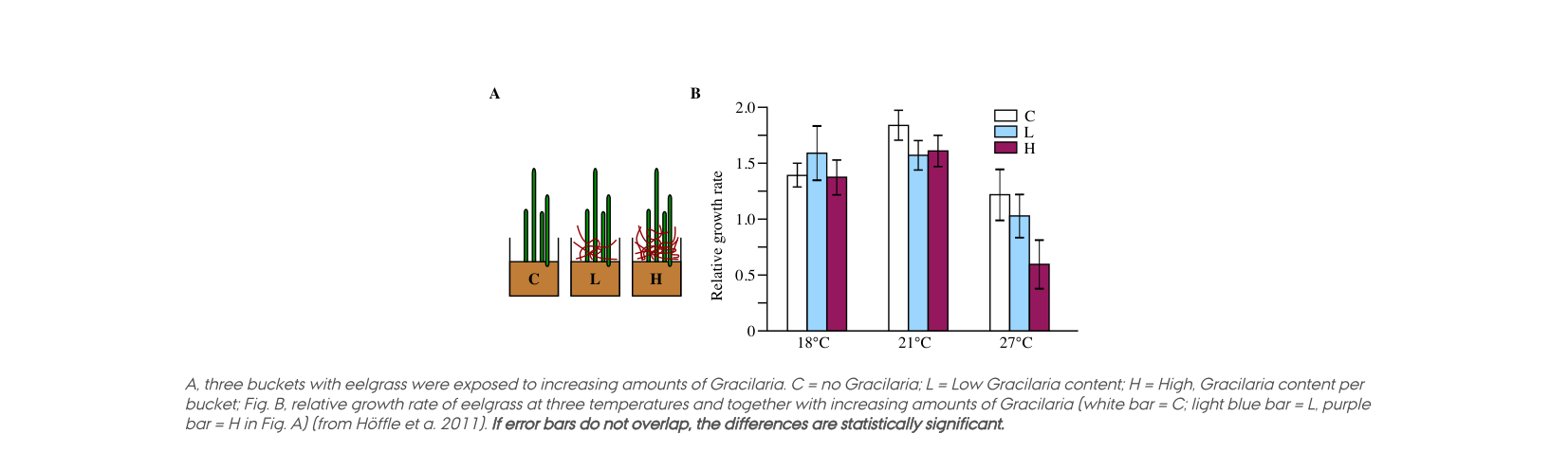 Figure 1.
Using the information and data, determine which of the statements are true or which are false.
Question reproduced from IBO 2015, Theoretical Exam A, licensed under CC BY-NC-SA 4.0 - attributed to the International Biology Olympiad. Open the full exam PDF · Community solutions (unofficial)