Q46 - Trade-offs Between Clonal and Sexual Reproduction in Bamboo
Many plants reproduce both sexually and vegetatively (clonally). A hypothesis says: As both reproductive modes require energy, a negative trade-off is expected to exist between the two reproductive modes. This was studied in a population of Japanese bamboo (Sasa veitchii) (Figs A-B). A, six plots each presenting the spatial distribution of a bamboo clone; black dots show the positions of all flowering culms of the clone; B, relationships between no. of flowering culms of a clone and its sexual success (measured in three ways).
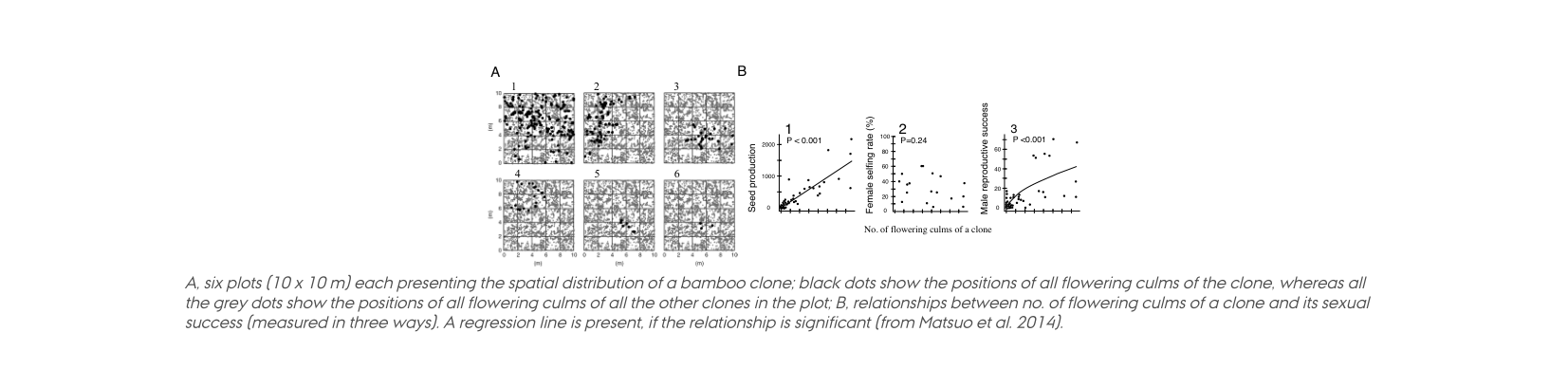 Figure 1.
Using the information and data, determine which of the statements are true or which are false.
Question reproduced from IBO 2015, Theoretical Exam A, licensed under CC BY-NC-SA 4.0 - attributed to the International Biology Olympiad. Open the full exam PDF · Community solutions (unofficial)