Q47 - Prey-Induced Enzyme Activity in the Carnivorous Sundew
The carnivorous plant sundew, Drosera capensis, has tentacles with mucilage on their leaf surface. In an experiment, plants were each fed 50 fruit flies per day for ten weeks (Table). The weight of each fruit fly was measured before and after digestion, showing an average dry weight loss of 60%. Estimates of different parameters are given in table. Enzyme activity in mucilage was estimated 24 h after either being fed with fruit flies or exposed to mechanical irritation (the addition of polystyrene balls, which were the size of fruit flies). Activities of AP and PD, PA and nutrient levels in leaf tissue.
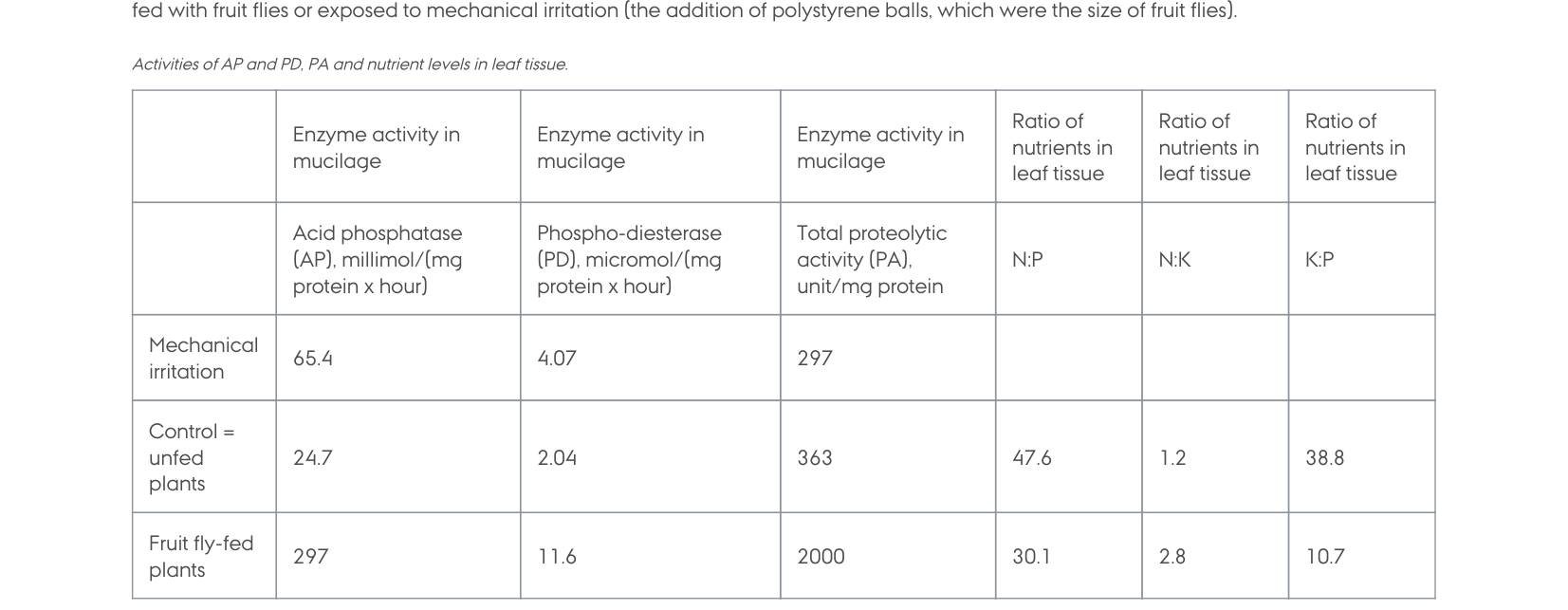 Figure 1.
Using the information and data, determine which of the statements are true or which are false.
Question reproduced from IBO 2015, Theoretical Exam A, licensed under CC BY-NC-SA 4.0 - attributed to the International Biology Olympiad. Open the full exam PDF · Community solutions (unofficial)