Q49 - Heterostyly and Pollen Transfer Efficiency in Primrose
Primrose has heterostyly, i.e. two flower forms on different individuals: P-plants with long style and short stamens inside the corollar tube, and T-plants with short style and stamens higher in the corolla (Fig. A). Darwin crossed T x P primroses (Table), and found that heterostyly increases outcrossing and thus fruit set. A bee inserts its tongue in a P-flower and gets pollen on the tip of its tongue, and then places the pollen on the stigma of a T-plant and vice versa for T-pollen to P-stigma (Fig. B). Heterostyly is controlled by one gene (T is Ss and P is ss; SS is non-viable, S is dominant to s). A, flower forms P (left) and T (right) of primrose; B, flowers P and T, with a bee’s tongue in between; arrows show amount of pollen transferred along different routes from the anther, to tongue and to the stigma. Fruit set (Number of fruits) after 100 T x T and P x P crossings and 100 T x P and P x T crossings.
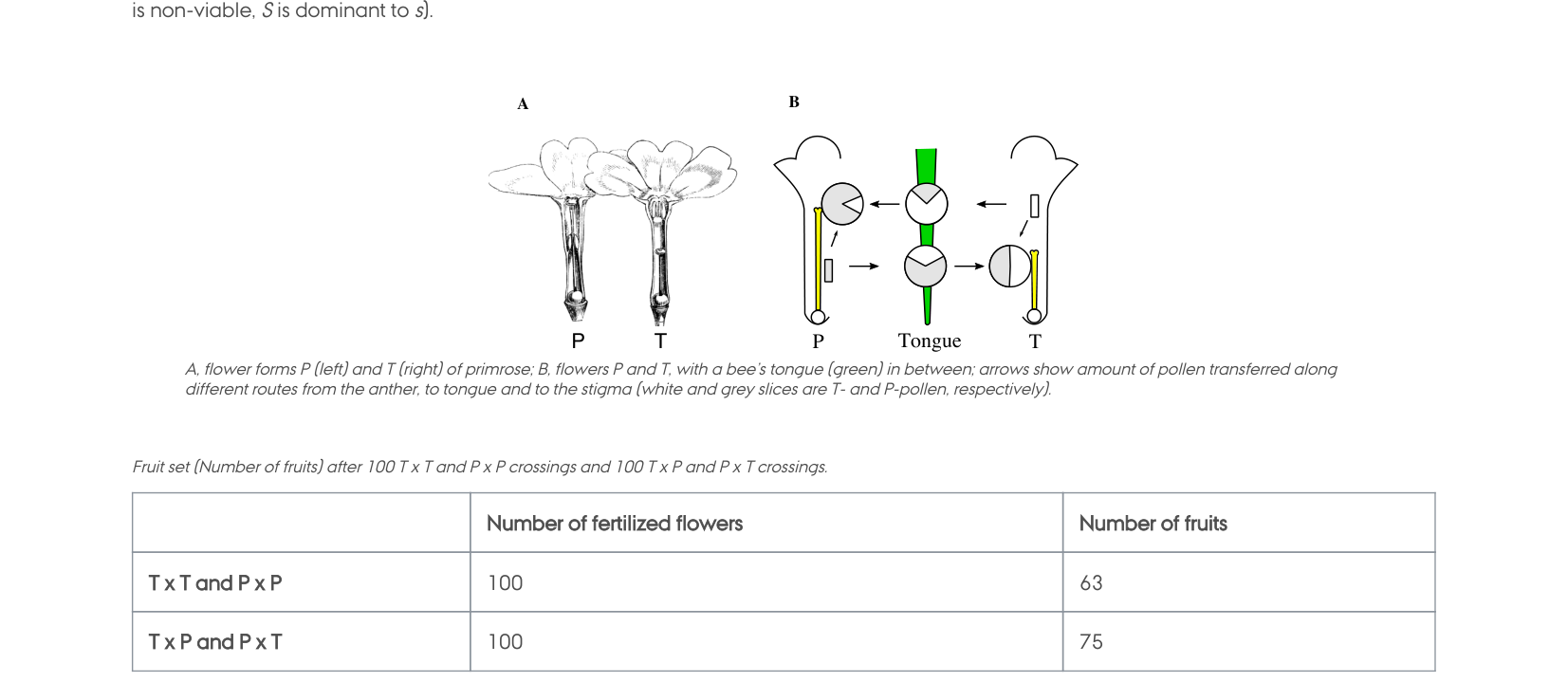 Figure 1.
Using the information and data, determine which of the statements are true or which are false.
Question reproduced from IBO 2015, Theoretical Exam A, licensed under CC BY-NC-SA 4.0 - attributed to the International Biology Olympiad. Open the full exam PDF · Community solutions (unofficial)