Q6 - Vascular Adaptations Preventing Leg Oedema in Giraffes
The giraffe has the highest mean arterial blood pressure of any mammal. This renders it vulnerable to leg oedema. How the animal prevents this was studied with a focus on vascular adaptations in the leg (Fig.). A-B, a series of cross-sections of leg arteries (a true and a false option); C, amount of elastin in arterial walls at increasing distance from the heart; D, number of nerves along arteries in the legs.
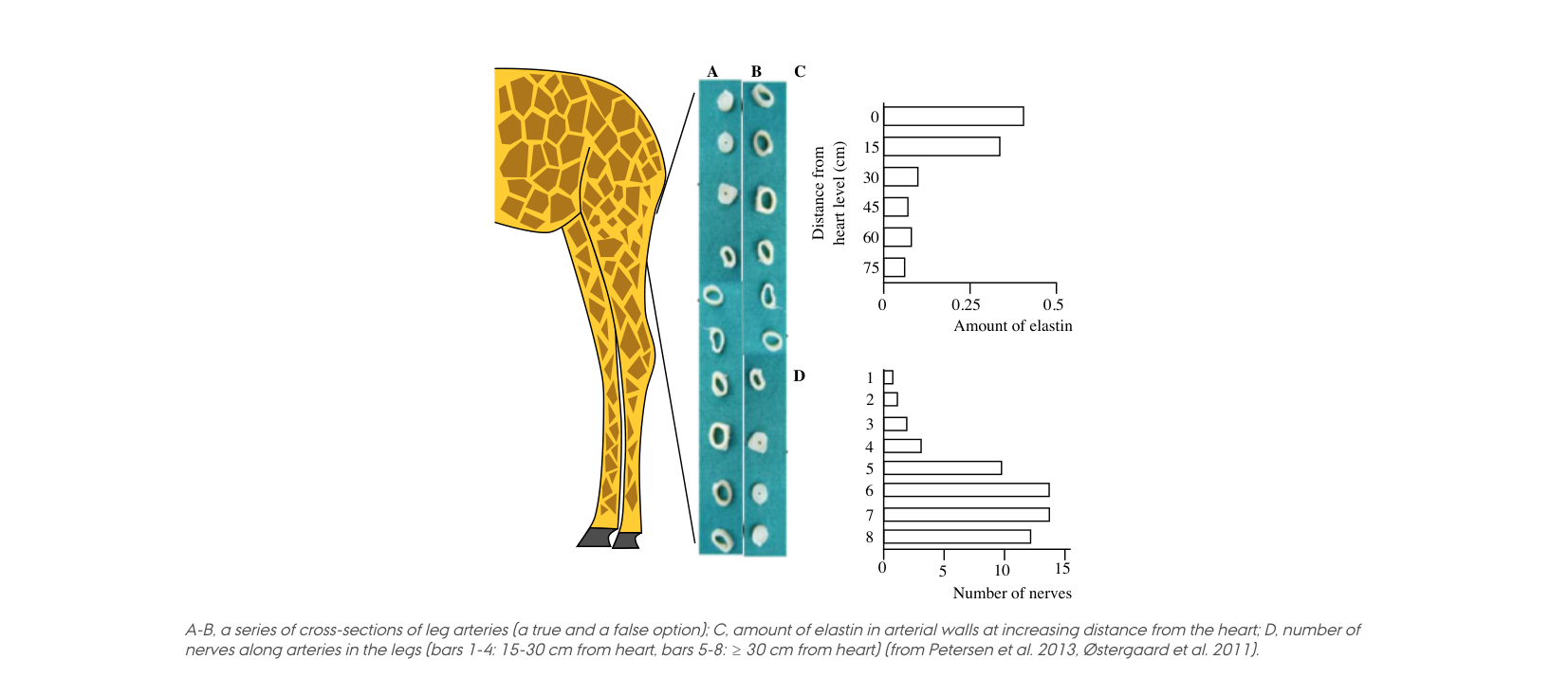 Figure 1.
Using the information and data, determine which of the statements are true or which are false.
A. Since arterial pressure at entrance to skull has to be similar to other mammals (c. 100 mm Hg), blood pressure down at the level of the hooves becomes very low
B. The figures show how the diameter and wall thickness of arteries in the leg are expected to change; A is correct and B is wrong
C. Femoral arteries become more rigid distally toward the leg extremities
D. The giraffe has a special arterial mechanism above its knees to regulate blood pressure in the leg extremities
Question reproduced from IBO 2015, Theoretical Exam A, licensed under CC BY-NC-SA 4.0 - attributed to the International Biology Olympiad. Open the full exam PDF · Community solutions (unofficial)