Q7 - Vocalization Frequency and Body Size in Whales
Whales rely on sound for communication in a diverse way. In a study, vocalization measurements of two distantly related whales, Humpback and Bowhead, were compared to literature data from two other species (Fig.). Frequency bands of vocalizations (horizontal bars) and range of body mass for 4 whale species together with the transmission loss from sound absorption in seawater at 10, 100 and 1000 km from source.
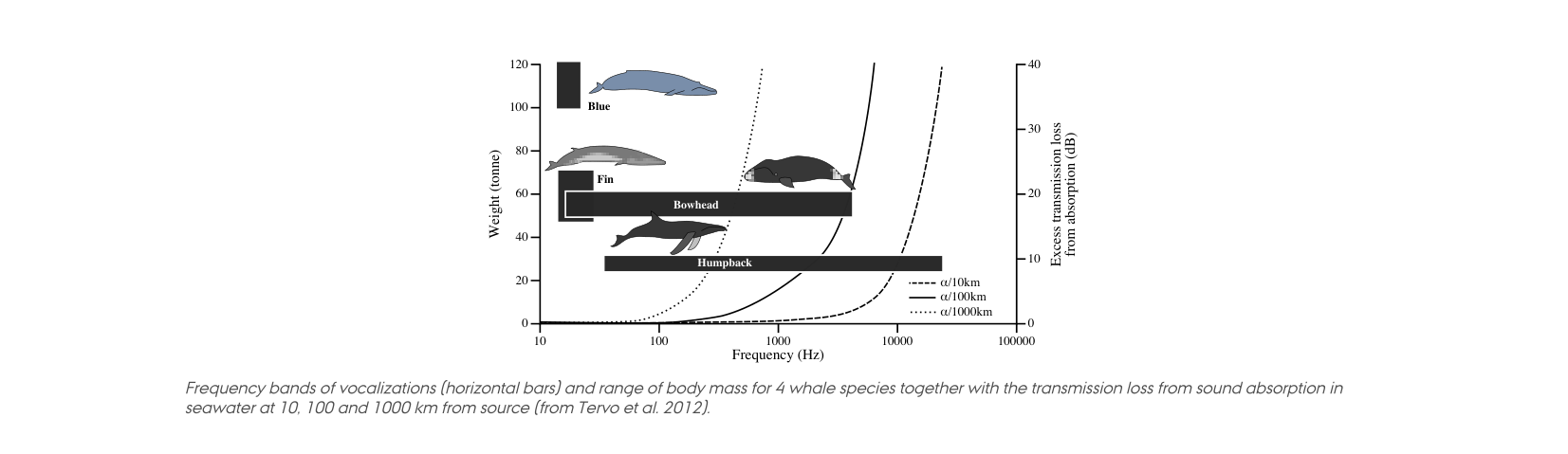 Figure 1.
Using the information and data, determine which of the statements are true or which are false.
A. Larger whales are expected to produce lower frequency signals than smaller whales do
B. Based on vocalizations, the Blue whale is expected to have more complex social behaviour than the Humpback.
C. Humpback and Bowhead have a signalling frequency that makes it possible for them to have high inter-annual mating site-fidelity
D. The similar vocalization patterns of Humpback and Bowhead whales are most likely due to convergent evolution
Question reproduced from IBO 2015, Theoretical Exam A, licensed under CC BY-NC-SA 4.0 - attributed to the International Biology Olympiad. Open the full exam PDF · Community solutions (unofficial)