Q10 - Altitude Adaptation in Deer Mouse Hemoglobin
Deer mice have a wide geographic range, e.g. with respect to altitude. This is partly explained by their respiratory physiology (Fig.).
A, oxygen saturation (%) of blood of deer mice from low and high altitude habitats as a function of the partial pressure of atmospheric oxygen PO₂; B, P50 is the partial PO₂ at which the blood is 50% O2-saturated, here plotted against the BPG (2,3-bisphosphoglycerate) : hemoglobin ratio. BPG affects the oxygen affinity of hemoglobin (from Tufts et al. 2013).
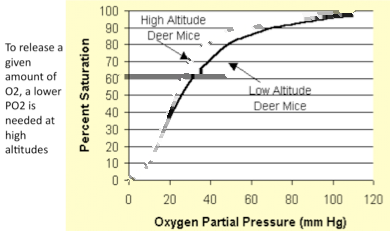 Figure 1.
Using the information and data, determine which of the statements are true or which are false.
Question reproduced from IBO 2015, Theoretical Exam B, licensed under CC BY-NC-SA 4.0 - attributed to the International Biology Olympiad. Open the full exam PDF · Community solutions (unofficial)