Q11 - Glycemic Index and Metabolic Response During Exercise
The effect of consuming foods, which varied in their glycemic index (GI), on prolonged exercise were studied. GI expresses the effect of a particular type of food on a person’s blood glucose level. At start of test, each person either got 1) Control, i.e. water (black squares); 2) LGI, i.e. a low GI meal + water (blue triangles), or 3) HGI, i.e. a high GI meal + water (red circles). Afterwards, each person rested, then cycled for 1 hr at 65% of her VO₂max, and finally at 90% VO₂max until exhaustion. Blood samples were taken before and during tests to measure levels of lactate, glucose and insulin (Fig.).
Levels of lactate A), glucose (B) and insulin in blood (C) before (pre-exercise) and during test. Each curve represents a treatment (red circles: high GI, blue triangles: low GI, black squares: control) (from Jamurtas et al. 2011).
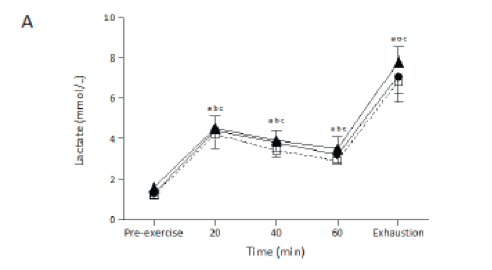 Figure 1.
Using the information and data, determine which of the statements are true or which are false.
Question reproduced from IBO 2015, Theoretical Exam B, licensed under CC BY-NC-SA 4.0 - attributed to the International Biology Olympiad. Open the full exam PDF · Community solutions (unofficial)