Q14 - Coevolution of Breeding and Pollination Systems in Figs
Figs and wasps have a long coevolutionary history. Figs depend on tiny wasps for pollination, which depend on fig inflorescences, because they lay eggs in the flowers and their larvae develop in the fruits. The breeding system of fig species may either be dioecy (with male and female trees) or monoecy (with hermaphroditic trees with male and female flowers). Wasps pollinate either actively, by carrying pollen in special body pockets or passively, without any specific pollen behaviour (Fig.).
Phylogenies of some groups of figs (left) and wasps (right). Breeding system (M = monoecy, D = dioecy) and pollination mode of wasps (P = passive, A = active; P/A = dimorphic) are mapped onto the phylogenies. Transitions between breeding systems and between pollination modes are shown as small vertical bars on phylogenies. Dashed lines give the mutualistic relationships (from Herre et al. 2008).
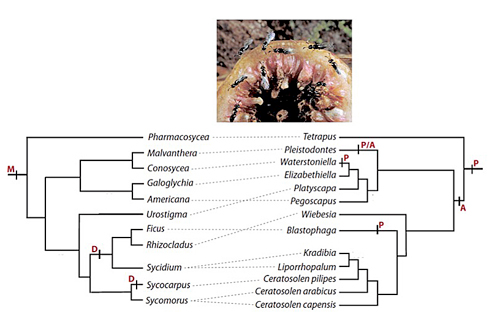 Figure 1.
Using the information and data, determine which of the statements are true or which are false.
Question reproduced from IBO 2015, Theoretical Exam B, licensed under CC BY-NC-SA 4.0 - attributed to the International Biology Olympiad. Open the full exam PDF · Community solutions (unofficial)