Q37 - Frog Phylogeny and Gondwanan Biogeography
The phylogeny of frogs has a very dynamic geographical history (Fig.).
Phylogeny of frog groups (branch lengths proportional to absolute time). Error bars on internal nodes are confidence intervals on the node dates; below and above the phylogeny is a geological time scale, and below the lower time scale is a cartoon for the period between the isolation of the Madagascar-India continental block from Africa (A) (130 mill. years ago, Ma) to the collision of India with Eurasia (D) (56 Ma) (shaded area in phylogeny, A–D in cartoon refer to A–D in lower time scale; K–T = Cretaceous–Tertiary boundary) (from Bossuyt & Milinkovitch 2001).
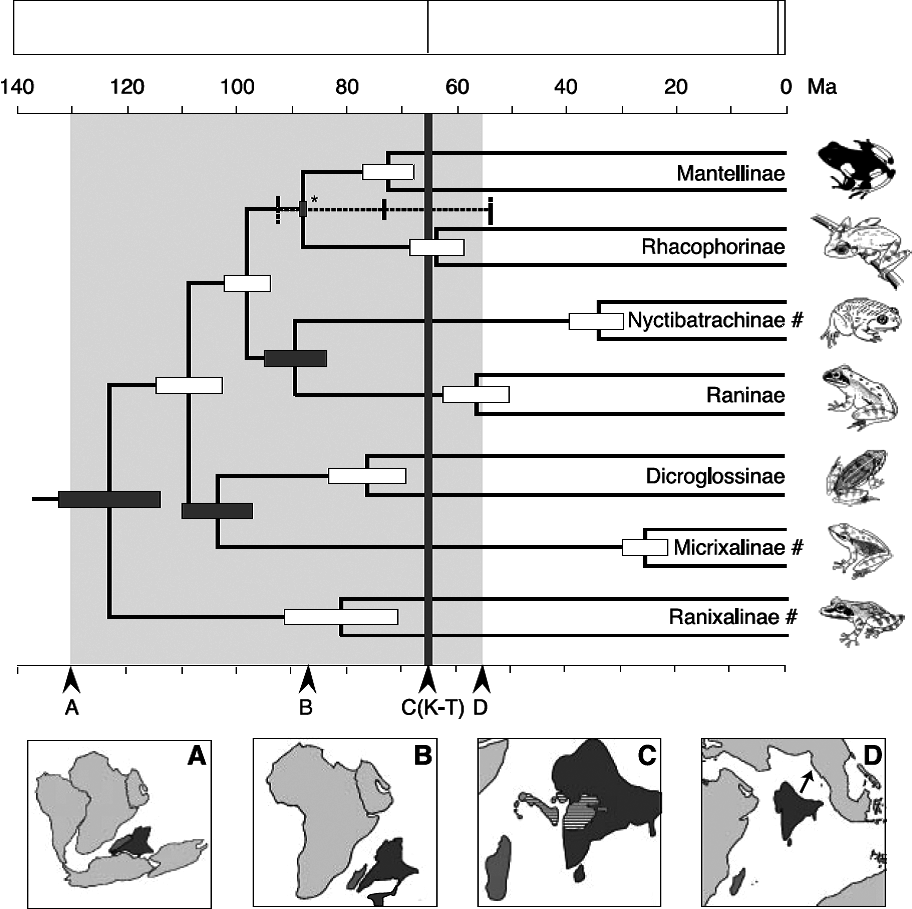 Figure 1.
Using the information and data, determine which of the statements are true or which are false.
Question reproduced from IBO 2015, Theoretical Exam B, licensed under CC BY-NC-SA 4.0 - attributed to the International Biology Olympiad. Open the full exam PDF · Community solutions (unofficial)