Q38 - Salinity and Genetic Structure Among Baltic Fish
The marine transition area between the Bothnian Bay (the northernmost part of the Baltic Sea between Sweden and Finland) and the Eastern Atlantic ocean is characterized by a steep cline in salinity (Fig. B) and it is inhabited by a number of fish species. Studies show genetic differences, measured as FST (Fig.) between two populations, one being the Bothian Bay population, which is considered the reference population. FST = 0 means complete random mating across populations, FST = 1 means no mating between populations.
Figure. A, Bothnian Bay (I), Southern Baltic Sea (II), and North Sea (III); B, changes in genetic variation among populations (FST) of five fish species (blue filled circles = flounder (inset); red filled inverted triangles = herring (inset); open squares, triangles, and circles= three other fish species); C, change in salinity [NaCl] from the Bothnian Bay (I) towards the North Sea (III) (from Limborg et al. 2009).
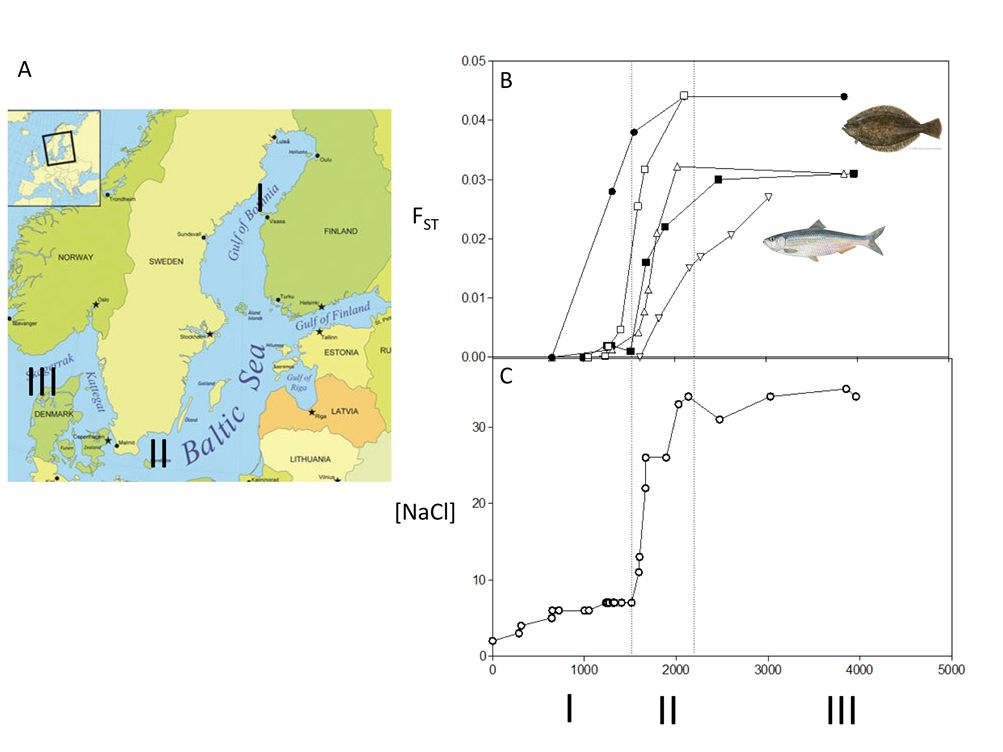 Figure 1.
Using the information and data, determine which of the statements are true or which are false.
Question reproduced from IBO 2015, Theoretical Exam B, licensed under CC BY-NC-SA 4.0 - attributed to the International Biology Olympiad. Open the full exam PDF · Community solutions (unofficial)