Q4 - Gut Hormones and Insulin Secretion After Gastric Bypass
Morbid obesity can be treated surgically by a gastric bypass, where a part of the stomach and the proximal part of the intestine are bypassed. A group of obese individuals were enrolled in a study, in which their glucose and hormone levels were measured after an ingestion of glucose before and after gastric bypass surgery (Fig.).
Effects of a glucose ingestion at time = 0 on the level of various parameters. Black circles indicate levels before gastric bypass, and blue diamonds indicate levels 3 months after gastric bypass. A, glucose level; Fig. B–C, insulin concentration and its secretion rate (ISR); Fig. D, Glucagon-Like Peptide 1 (GLP-1, gut hormone); and Fig. E, Gastric Inhibitory Polypeptide (GIP, gut hormone) (from Jørgensen et al. 2013).
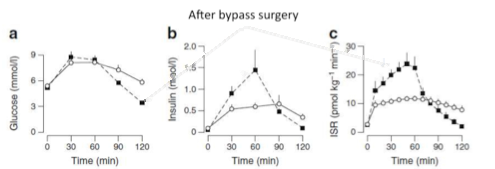 Figure 1.
Using the information and data, determine which of the statements are true or which are false.
Question reproduced from IBO 2015, Theoretical Exam B, licensed under CC BY-NC-SA 4.0 - attributed to the International Biology Olympiad. Open the full exam PDF · Community solutions (unofficial)