Q5 - Hummingbird Physiology Across an Elevation Gradient
Partial atmospheric oxygen pressure PO₂ and ambient temperature decrease with increased elevation above sea level. This affects the respiratory physiology and species richness of many animal groups, e.g. hummingbirds (Fig.). An important physiological feature of hummingbirds is their ability to enter torpor, a state of reduced physiological activity, to save energy.
A, relationship between heart mass and body mass of hummingbird species; B, average body mass (grams) per 500 m altitudinal zone (histogram, right Y-axis) and number of species of hummingbirds (x–x–line, left Y-axis) at different elevations (lower X-axis). The percentage of partial oxygen pressure compared to sea level is also given (from Altshuler & Dudley 2002).
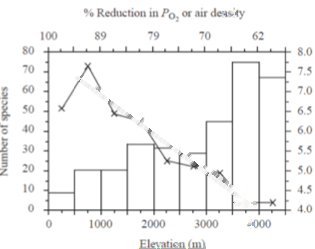 Figure 1.
Using the information and data, determine which of the statements are true or which are false.
Question reproduced from IBO 2015, Theoretical Exam B, licensed under CC BY-NC-SA 4.0 - attributed to the International Biology Olympiad. Open the full exam PDF · Community solutions (unofficial)