Q48 - Reproductive Success in a Deceptively Pollinated Orchid
Some plants deceive their pollinators by emitting odours, mimicking rotten flesh or dung. Such plants are pollinated by carrion and dung flies. This phenomenon is common among orchids, e.g. Bulbophyllum variegatum, three populations (ML, BB and ED) of which were studied at three different locations on the island of Réunion (Fig.).
Reproductive data from populations ML, BB and ED (from Humeau et al. 2011).
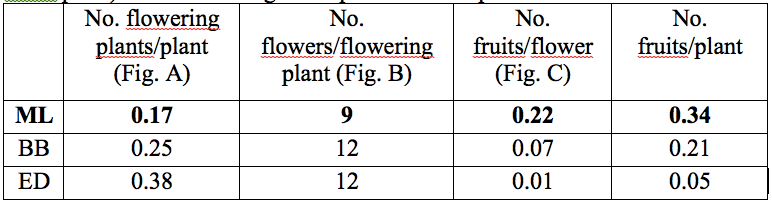 Figure 1.
Using the information and data, determine which of the statements are true or which are false.
A. Number of fruits produced per plant is higher in BB than in ML and ED
B. Compared to ML and BB, fruit set in ED may have severe pollinator limitation
C. Compared to ED and BB, ML may be a neighbour to cattle pastures
D. Compared to ED and BB, ML may be a relatively young population
Question reproduced from IBO 2015, Theoretical Exam B, licensed under CC BY-NC-SA 4.0 - attributed to the International Biology Olympiad. Open the full exam PDF · Community solutions (unofficial)