Q47 - Nutrient Limitation of Baltic Phytoplankton Groups
Countries around the Baltic Sea have agreed to reduce the outlet of nutrients in drainage water, especially N. In a study, growth of diatoms, N-fixing cyanobacteria and dinoflagellates was monitored together with the seawater N: P ratio to estimate the effects of outlet reduction. Optimum N: P ratio for growth in the three groups is approximately 7.
Annual variation in biomass of the three study groups (A) and seawater N: P-ratio (B) (from FF 1998).
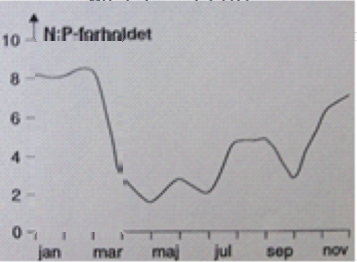 Figure 1.
Using the information and data, determine which of the statements are true or which are false.
Question reproduced from IBO 2015, Theoretical Exam B, licensed under CC BY-NC-SA 4.0 - attributed to the International Biology Olympiad. Open the full exam PDF · Community solutions (unofficial)