Q1 - Wee1/Cdc25 Feedback Control of M-Cdk Activity
The activities of Wee1 kinase and Cdc25 phosphatase determine the state of phosphorylation of tyrosine 15 in the Cdk1 component of M-Cdk. When tyrosine 15 is phosphorylated, M-Cdk is inactive; when tyrosine 15 is not phosphorylated, M-Cdk is active (Figure Q.1A). The activities of Wee1 kinase and Cdc25 phosphatase are also controlled by phosphorylation. The regulation of these activities can be studied in extracts of frog oocytes. In such extracts, Wee1 kinase is active and Cdc25 phosphatase is inactive. As a result, M-Cdk is inactive because its Cdk1 component is phosphorylated on tyrosine 15. M-Cdk in these extracts can be rapidly activated by addition of okadaic acid, which is a potent inhibitor of serine/threonine protein phosphatases. Using antibodies specific for Cdk1, Wee1 kinase, and Cdc25 phosphatase, it is possible to examine their phosphorylation states by changes in mobility upon gel electrophoresis (Figure Q.1B). Phosphorylated forms of these proteins generally migrate more slowly than their nonphosphorylated counterparts.
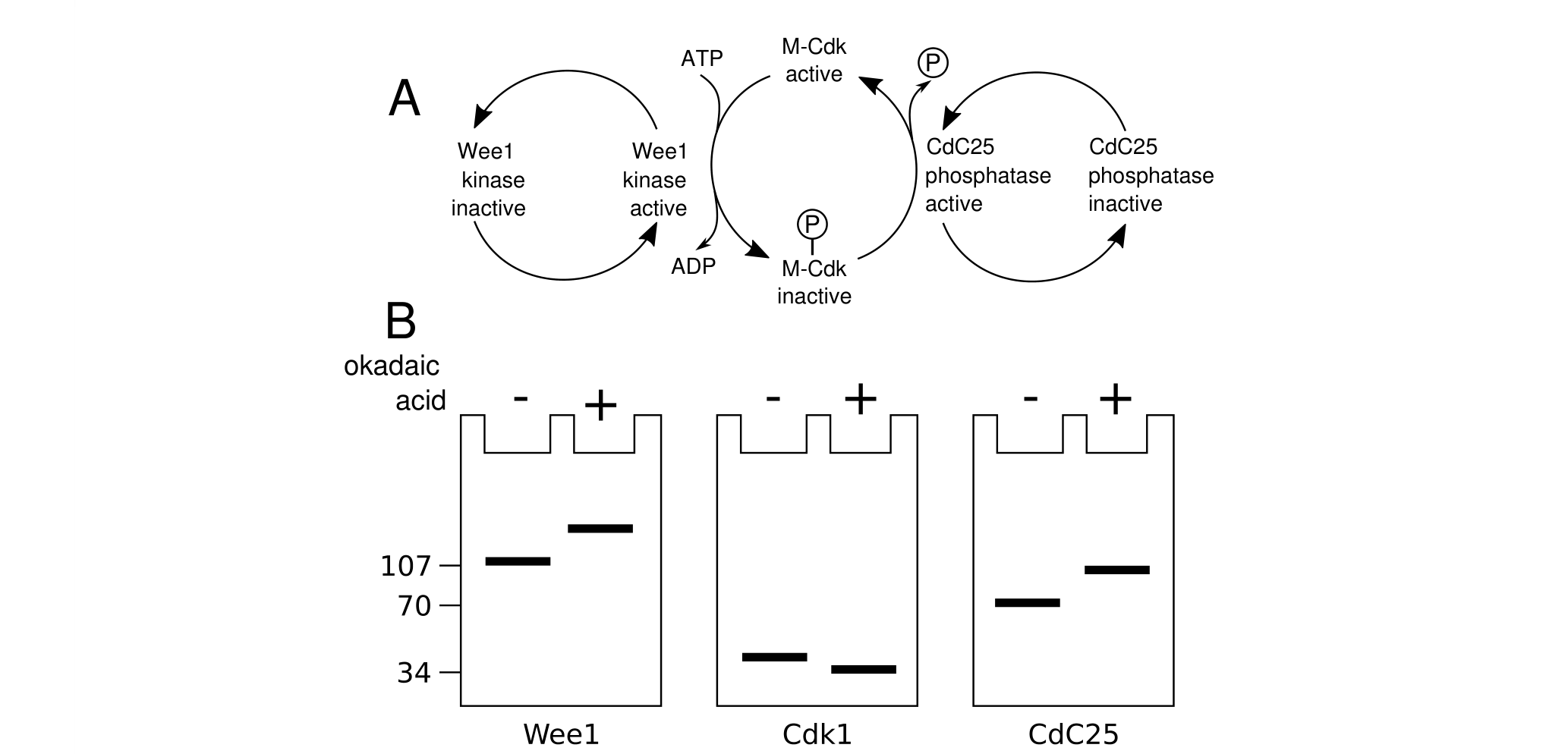 Figure 1.
Using the information and data, determine which of the statements are true or which are false.
Question reproduced from IBO 2016, Theoretical Paper A, licensed under CC BY-NC-SA 4.0 - attributed to the International Biology Olympiad. Open the full exam PDF · Community solutions (unofficial)