Q14 - Symplastic vs Apoplastic Phloem Loading of Sucrose
Sucrose is produced in leaves and translocated short and long distances through veins to non-photosynthetic organs such as roots, stems, flowers and fruits. Two principal pathways, symplastic and apoplastic, describe how sucrose molecules are transported into the phloem of leaves, as shown in Fig.Q14.
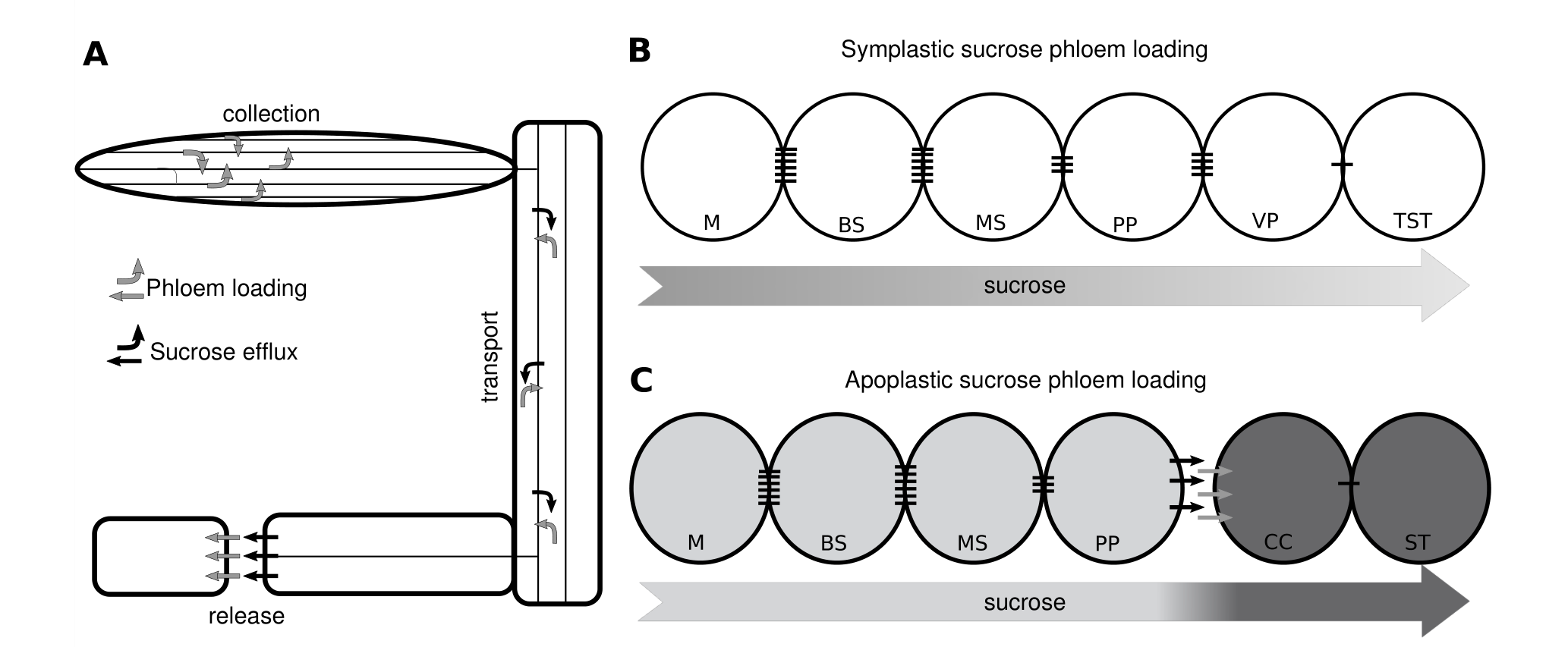 Figure 1.
Using the information and data, determine which of the statements are true or which are false.
A. Sucrose is synthesized in leaves and transported long distance through phloem to sinks under hydrostatic pressure gradient.
B. Loading sucrose in apoplastic pathway requires energy in several steps due to the movement across secondary wall of living cells.
C. In the symplastic pathway, sucrose molecules are passively loaded through plasmodesmata.
D. Unloading sucrose molecules at the sinks requires no energy release because of movement down a concentration gradient of sucrose.
Question reproduced from IBO 2016, Theoretical Paper A, licensed under CC BY-NC-SA 4.0 - attributed to the International Biology Olympiad. Open the full exam PDF · Community solutions (unofficial)