Q16 - Arsenic Accumulation and Growth in Athyrium yokoscense
Arsenic (As) in the soil has become an environmental concern worldwide because it is difficult to remediate and can adversely impact human health. The fern, Athyrium yokoscense is well known as a Cd hyperaccumulator as well as a Cu, Pb and Zn tolerant plant. However, no information is available on As accumulation by A. yokoscense, although it often grows in soils containing high levels of several heavy metals and As. To understand As accumulation in A. yokoscense, a student conducted an experiment in which young ferns collected from a mining area were grown in media containing As-spiked paddy soils or mine soil in a greenhouse for 21 weeks. Before transplanting, fern biomass was 0.26 ± 0.08 g plant-1 DW and As concentrations of young and old fronds were 7.8 ± 0.3 and 57.7 ± 2.2 mg kg-1, respectively.
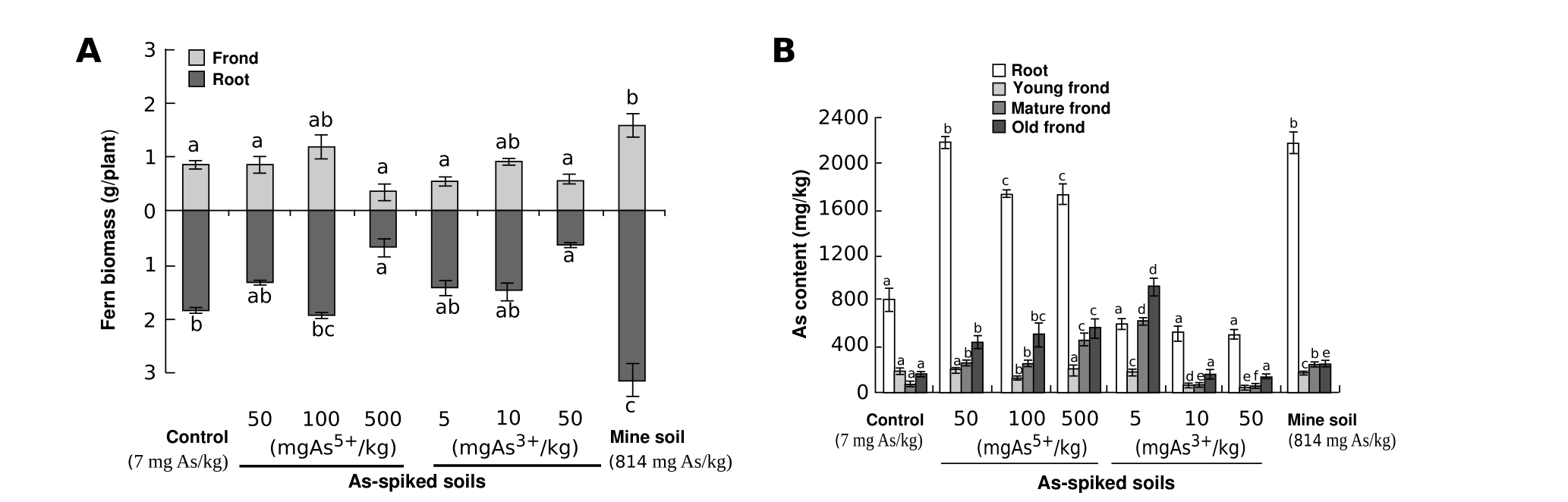 Figure 1.
Using the information and data, determine which of the statements are true or which are false.
Question reproduced from IBO 2016, Theoretical Paper A, licensed under CC BY-NC-SA 4.0 - attributed to the International Biology Olympiad. Open the full exam PDF · Community solutions (unofficial)