Q17 - ABA and Ethephon Effects on Sweet Cherry Ripening
To study the effect of phytohormones on fruit maturation, researchers used abscisic acid (ABA) and ethephon to treat sweet cherry fruits and afterward evaluated the expression of the PacNCED1 gene, which encodes 9-cis-epoxycarotenoid dioxygenase, a key enzyme in ABA biosynthesis. They also checked the expression of the PacACO1 gene, encoding 1-aminocyclopropane-1-carboxylic acid oxidase, an enzyme involved in ethylene biosynthesis. The transcript of PacACT1 (a beta-actin cDNA fragment) was used to standardize all expression measurements (Fig.Q17-D).
| Treatment | Firmness of pulp | Soluble solids content/titratable acidity | Anthocyanin (U.g-1) |
|---|---|---|---|
| Control | 20.3a | 14.4a | 13.4a |
| Ethephon | 19.6a | 15.3a | 14.4a |
| ABA | 11.9b | 16.8b | 23.8b |
(a and b indicate values that are significantly different.)
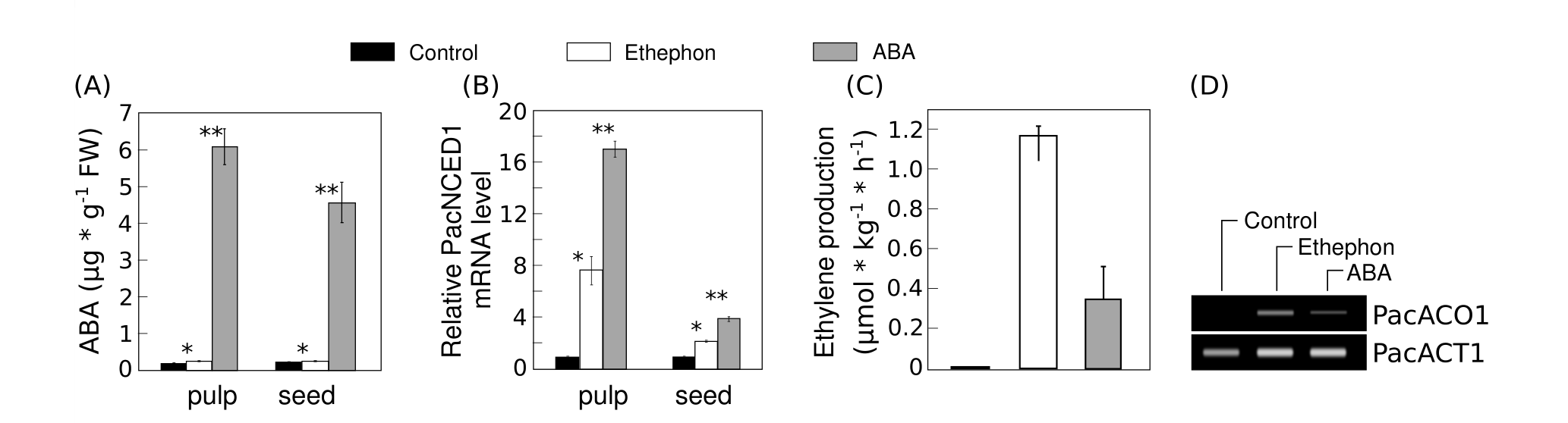 Figure 1.
Using the information and data, determine which of the statements are true or which are false.
Question reproduced from IBO 2016, Theoretical Paper A, licensed under CC BY-NC-SA 4.0 - attributed to the International Biology Olympiad. Open the full exam PDF · Community solutions (unofficial)