Q62 - Habitat-Linked Hydraulic Vulnerability in Ranunculus Species
To understand the effect of desiccation on herbaceous plants and their responses, scientists conducted a study on three Ranunculus species in their natural habitats, including R. bulbosus in dry meadow, R. lanuginosus in humid meadow, and R. acris in both habitats. They measured leaf water potential and hydraulic conductance of these species in response to dehydration (Fig.Q62). Xylem staining experiment on R. acris in dry habitat was used to estimate loss of conductivity due to embolism. An estimated 50% loss of xylem hydraulic conductivity occurred at -2MPa or less owing to embolism. Previously, leaf hydraulic vulnerability studies found 50% reduction in leaf hydraulic conductance between -1 and -1.8 MPa in perennial grasses and at -1.8 MPa in woody plant species.
Figure Q.62 Leaf hydraulic conductance (Lhc) of Ranunculus species/populations in response to dehydration. Solid and dashed vertical lines indicate, respectively, fitted 50% and 88% leaf hydraulic conductance losses.
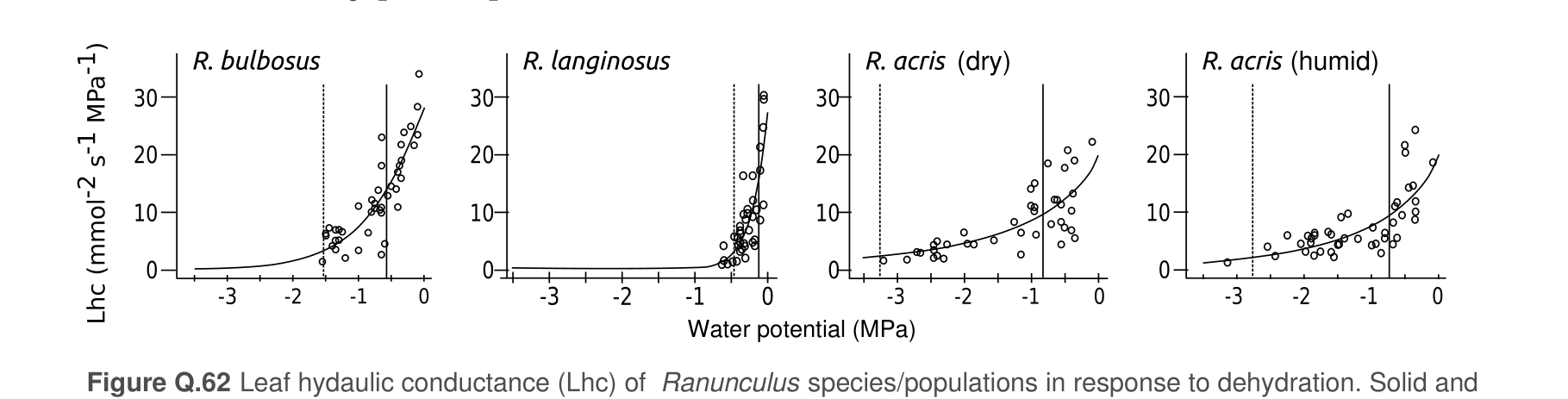 Figure 1.
Using the information and data, determine which of the statements are true or which are false.
Question reproduced from IBO 2016, Theoretical Paper B, licensed under CC BY-NC-SA 4.0 - attributed to the International Biology Olympiad. Open the full exam PDF · Community solutions (unofficial)