Q75 - Distinguishing Obstructive and Restrictive Patterns on a Flow-Volume Loop
In a simple way, respiratory disorders can be classified as obstructive or restrictive disorders. Obstructive disorders are characterized by a reduction in the airflow rate in the respiratory tracts. Restrictive disorders are characterized by a reduction of lung volume.
Figure Q.75 shows the shapes of the flow-volume loops measured during forced inspiration and forced expiration in healthy people with normal respiratory function and in four patients suffering from four common types of respiratory disorders (Type 1 through Type 4).
Figure Q.75
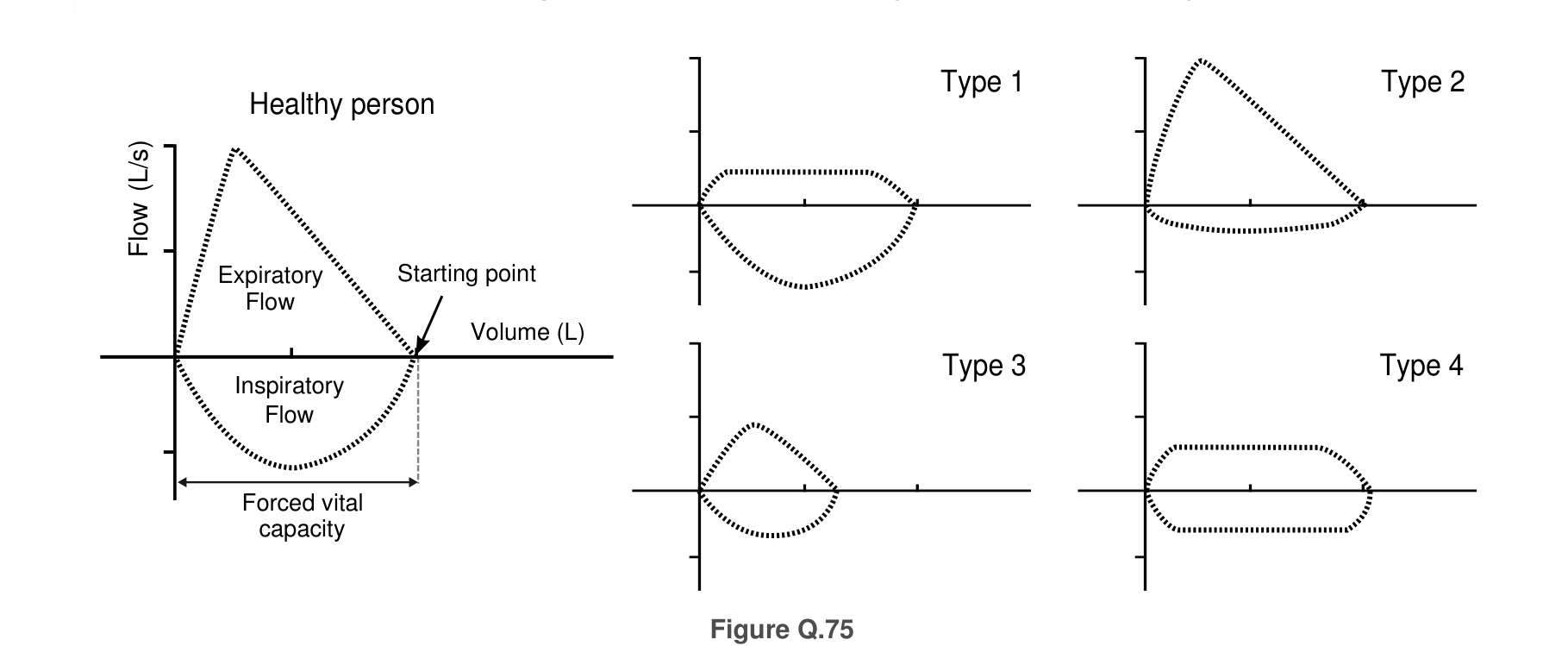 Figure 1.
Using the information and data, determine which of the statements are true or which are false.
Question reproduced from IBO 2016, Theoretical Paper B, licensed under CC BY-NC-SA 4.0 - attributed to the International Biology Olympiad. Open the full exam PDF · Community solutions (unofficial)