Figure Q.76A shows neuron X receives signals directly from three separate nerve
terminals b, c and d. Neuron Y receives signals from nerve terminal a.
Figure Q.76B shows the various postsynaptic potentials recorded in neuron X after
receiving input signals directly from terminals b, c, and d and indirectly from terminal
a.
Figure Q.76C shows the action potential recorded in neuron Y after receiving input
signals from the presynaptic terminal a.
Figures Q.76A, B, and C
Figure 1.
Using the information and data, determine which of the statements are true or which are false.
A. Action potentials could be generated in neuron X if nerve terminal c is stimulated rapidly.
B. When three nerve terminals a, c and d are stimulated simultaneously, the postsynaptic potentials recorded in neuron X are smaller than those when the nerve terminals c and d are stimulated simultaneously.
C. Nerve terminal a releases inhibitory neurotransmitter and nerve terminal b releases excitatory neurotransmitter.
D. In the mammalian body, there are many neurons like neurons Z, Y, X. Neurons Z, Y, X are sensory neurons, Renshaw cells (inhibitory neurons) and motor neurons, respectively. If a substance (e.g., Strychnine) injected in the body blocks glycine receptors, diaphragm contracts fully and remains contracted.
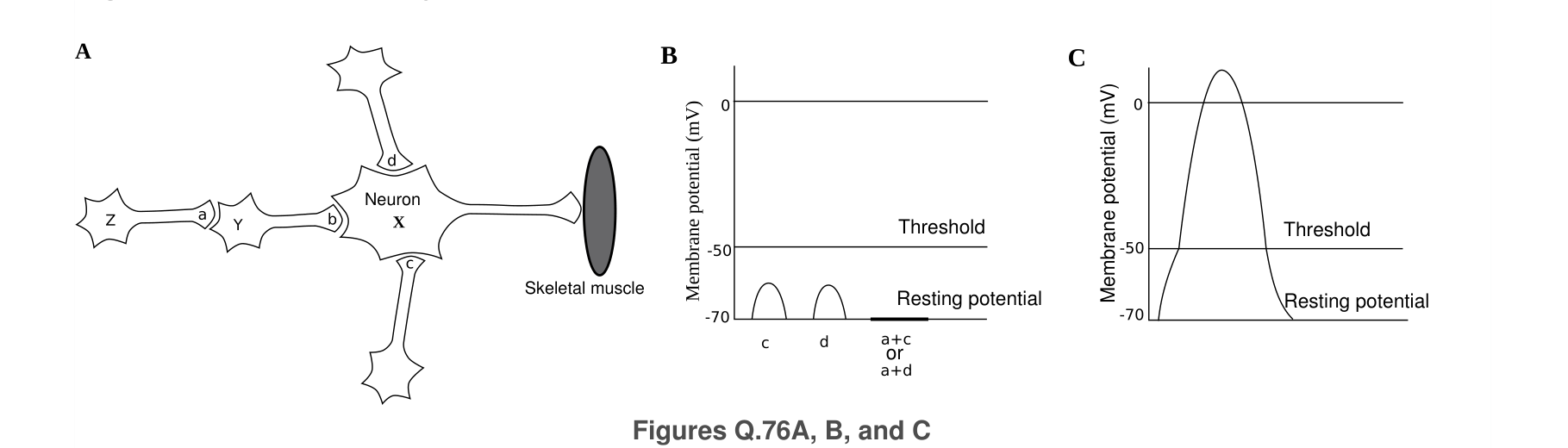 Figure 1.